Time for a European Competence Framework for Science Communication Professionals
What does it look like to be a science communication professional in Europe? What kind of skills and knowledge do different types of science communicators currently need? And how will those skills and that knowledge need to have changed in 10 years’ time? Those were the provocative questions asked during the first minutes of the fourth topic session in a series of Mutual Learning Exercises (MLE) on Science Communication in Research and Innovation, organised by COALESCE.
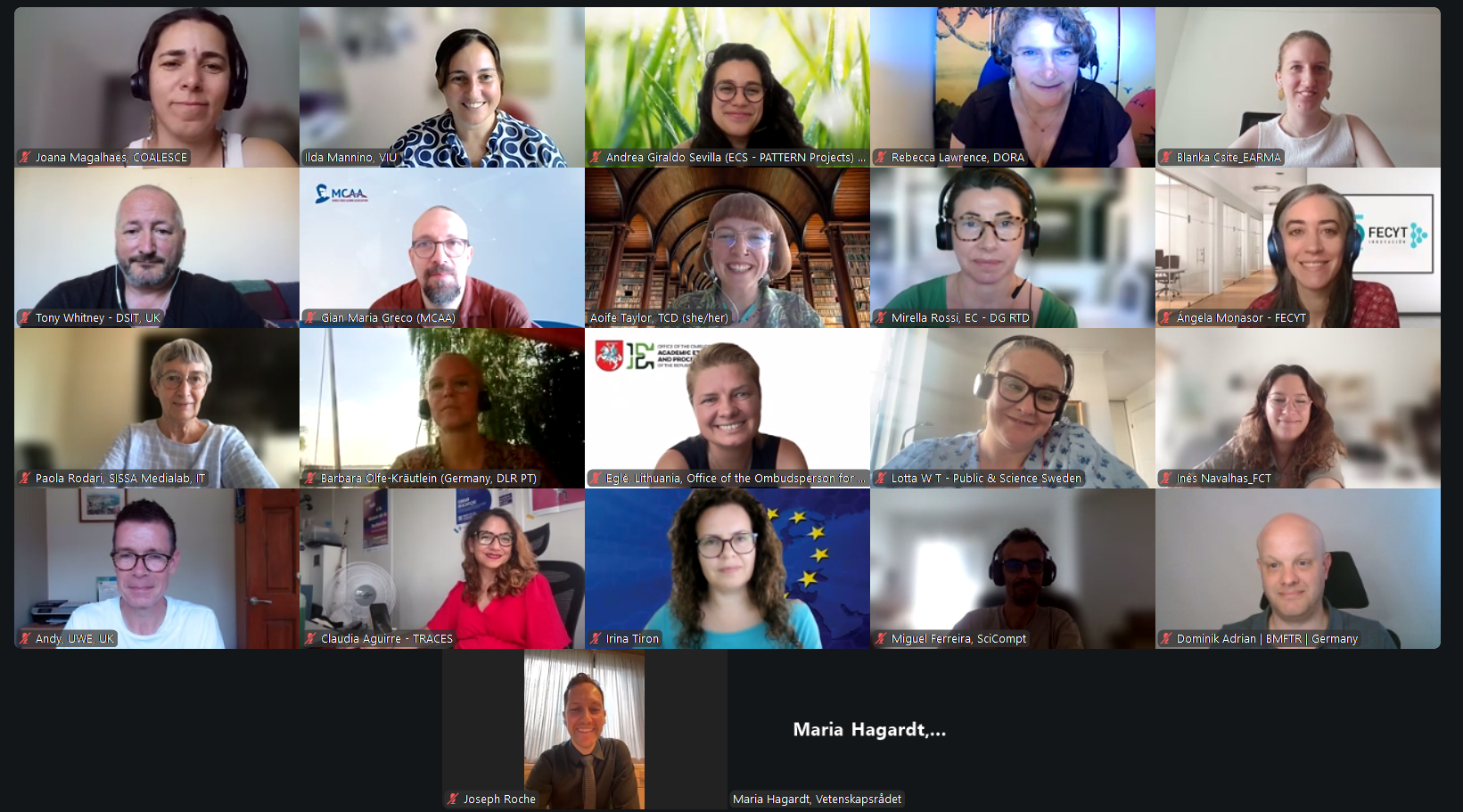
As with previous MLE sessions, the goal was to bring together European Research Area (ERA) member state representatives to discuss policy challenges and opportunities to support science communication. The meeting welcomed participants from France, Germany, Ireland, Italy, Lithuania, Portugal, Spain, Sweden and the UK.
Under the topic “Building skills and competences – towards a science communication competence framework”, participants in the MLE on 25 June were invited into a participatory exercise aimed at understanding professionalisation paths in science communication, learning about strategies for training and capacity building, fostering reward and recognition in science communication careers, and supporting the inclusion of science communication in local and national strategies.
Group discussions were preceded by a roundtable with Gian Maria Greco, outgoing Chair of the Marie Curie Alumni Association (MCAA); Rebecca Lawrence, vice-chair of the Declaration On Research Assessment (DORA); Blanka Csite, Policy and Project Officer at the European Association Research Managers and Administrators (EARMA); and Andrea Giraldo Sevilla, Research Manager at the European Citizen Science Project (ECS).
“Science communication should not become an extra burden to researchers – especially for early career researchers – it should not become something they must do, something more [in addition to the work they already have]. It has to become a possible competence that they need to have,” said Gian Maria Greco in the roundtable. The reason, he explains, is that science communication is a profession and one should support the professionalisation of science communication.
“We are continuously asking researchers to do more and more and to be experts at everything, all the way from doing the research to being expert mentors, experts in getting grants, experts in communicating. It is not realistic, and it doesn’t make any sense – different people have different strengths and different skills,” said Rebecca Lawrence. “The DORA recommendations are really aiming to encourage recognition of the different types of actors you need in a research team, with different types of expertise.”
The panellists also acknowledge there’s a lack of recognition for the work researchers do when engaging in outreach activities, and advocate for science communication to be recognised as a distinct, specialised and professional role. The problem, in many organisations, is that science communication is not integrated into the institutional strategy. Science communication “cannot become an afterthought,” said Gian Maria Greco. Science communication professionals should be involved in scientific projects from the conception stage, he added.
Rebecca Lawrence highlighted that each scientific project will have different outputs or will need to be communicated differently depending on who their target audience is, which means that science communicators need a broad set of skills or different types of science communication professionals need to be involved in a project (science writers, designers, multimedia professionals, educators, PR, etc.). “There is a lot of complexity and diversity that we need to support and recognise,” she said.
Speaking in the name of research managers, Blanka Csite acknowledged that the different professional groups represented at the meeting “face very similar issues and need to join forces to tackle them.” She added: “One of these ways is to find the interoperability between the competence frameworks and also of the trainings.” Based on the experience of the CitSci Comp, a citizen science competency framework for citizen science researchers and practitioners, Andrea Giraldo Sevilla also highlighted the interoperability within different frameworks as a lesson learnt.
Projects such as COALESCE, ECS, PATTERN, or EARMA have their own “academies” but also have overlapping target audiences. This means there’s a need for connection and complementarity, to guide the potential audiences to the resources and training that suit them better, whatever the project providing it might be. These connections are also a request from the European Commission.
The European Competence Framework for Researchers and the European Competence Framework for Research Managers, developed by the European Commission, make clear how important communication is. Communicating with the wider public and the media, increasing the impact of science in policy and society, and building trust, as well as critical thinking, problem solving, and creativity, are some of the competencies in these frameworks. Competence frameworks for different types of science communicators are now a priority and are being developed within COALESCE.
“Including the community of beneficiaries from the beginning helps ensure ownership and content validity, which was our main goal with the CitSci Comp [a competence framework for citizen science researchers and practitioners],” said Andrea Giraldo Sevilla. “[One of] the main lessons was how building the CitSci Comp with the field and not for it has helped us develop multi-career paths.”
The participatory activity in the second part of the meeting highlighted that despite the differences between countries, the lack of understanding about the importance of science communication (and quality science communication), scarce resources to communicate science, and limited training options in science communication are common ground. Creating university degrees in science communication, incorporating science communication in national strategies and institutional structures, and providing public funding for science communication were some of the priorities highlighted by attendees.
Some questions are still a work in progress, though. Which types of professionals should be included within a wide definition of ‘science communicator’? Do they need formal training, or is informal, ad hoc training enough? Which skills and competences do they need to ensure they are a future-proof, resilient and connected workforce?
The result of the ongoing discussions and the policy briefs underway will further contribute to the development of a Competence framework provided by the European Competence Centre for Science Communication that will guide potential trainers to build a rich and diverse training portfolio.