Curated library of high-quality resources launched to support science communicators across Europe
• In this article, “Upload resources step-by-step” (below)
A library of high-quality resources providing guidance, ideas and insights to anyone who communicates science has been released in the online European Competence Centre for Science Communication.
The SciComm Toolbox is a searchable library of guides, reports, and materials curated and quality-checked by volunteer reviewers under the coordination of an appointed Curation Board, managed by team members from the COALESCE project.
Resources currently available in the toolbox include a short guide to developing videos communicating science, informed by insights from an innovative experimental video ‘Kurzgesagt – In a Nutshell’, a short report on how citizen science can be a means to tackle misinformation, and a guide to quality criteria for online science communication. But there are many more.
These resources were developed within projects funded by the European Union’s Horizon 2020 program Science With and For Society (Swafs-19), including TRESCA, NEWSERA and ENJOI, as well as within COALESCE. In the future, it is planned for the toolbox to expand.
Anyone who has registered on the platform will be able to contribute by uploading resources supporting science communication so they can be considered for inclusion in the toolbox, as well as becoming a reviewer. These resources will be checked according to the standards, principles and criteria for quality science communication resources in a curation and review process, and will then be made available through the platform if they meet the standards.
“The toolbox is searchable by areas of science communication practice. So if someone is running a workshop on communicating science at times of crisis, they will be able to apply filters so that suitable resources will appear on the platform,” says Charlotte Bruns, a Postdoctoral Researcher and Lecturer at Erasmus University Rotterdam and one of the SciComm Toolbox Chief Curators.
Resources can receive special endorsements such as ‘easy to use’ for beginners, ‘scientifically validated’ for resources informed by research, ‘best practice’ for resources informed by practical experience and ‘trainers’ choice’ for resources that will be valuable to trainers. This will further provide recognition for those who created the resources and help platform users easily identify the best resources for them.
“The toolbox will support anyone communicating science, whether they are staff working in science museums or science centres, scientists or science journalists. One added value that we included is that users will be able to comment on resources and facilitate connections between those who created them and those who may wish to replicate or collaborate further,” says Joana Magalhães, COALESCE co-coordinator and leader of the Competence Centre platform development. “The toolbox’s release is a significant landmark in the COALESCE project as it will be a valuable resource for anyone communicating science, and we are looking forward to watching it grow.”
Upload resources step-by-step
-
- Register and log in to the Competence Centre platform.
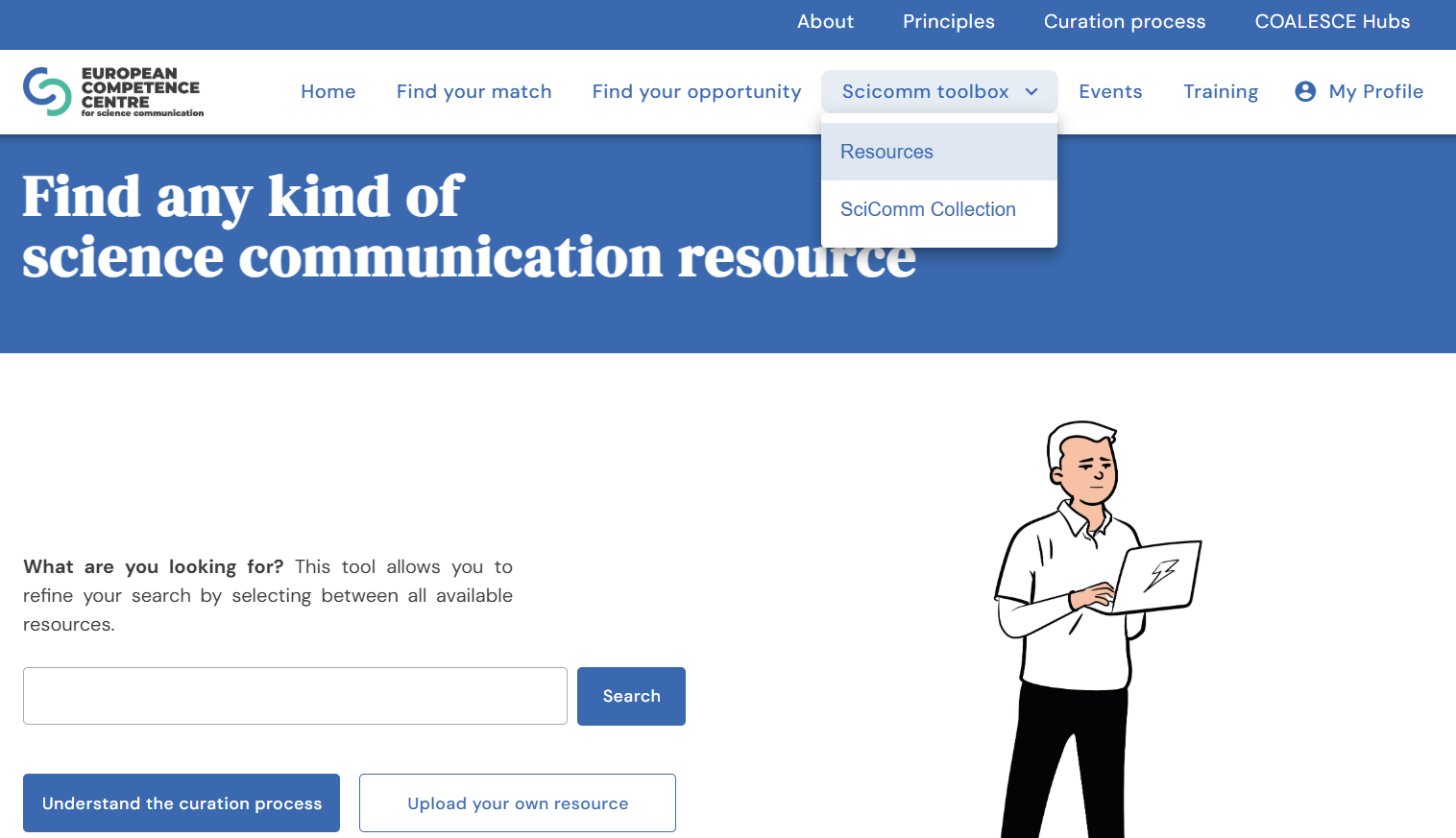
- Go to SciComm Toolbox | Resources menu on the Competence Centre platform and “Upload your own resource” or go to “My Resources” | Add New in your account.
- Make sure to read “Understand the curation process” before you proceed. The curation process may take two to three weeks.
- The resources must be about science communication and offer practical tips for activities like public engagement, science writing, science visualisation, etc.
- You are welcome to include:
- Practical toolkits and guides
- How-to manuals and handbooks
- Best practice compilations
- Case studies and examples with accompanying suggestions
- Training materials
- Academic publications, research reports, and white papers that include practical suggestions
- Media content (e.g., podcasts, video clips, magazine articles) that includes practical suggestions
- We are currently not covering:
- Policy papers and position statements
- Academic publications, research reports and white papers that are theoretical or descriptive
- Media content that is descriptive and does not include systematised practical advice
- Examples of excellent science communication that detail how they can be applied by practitioners
- When adding your resource:
- Don’t forget to include:
- Title
- Short description
- Names of all authors
- PDF or link to the resource (which needs to be open access)
- Type of resource
- Year of publication
- Be sure you have the right to share that resource publicly.
- You will be asked about:
- Topic of the resource (always within science communication)
- Values promoted
- Target audience
- Learner level
- Additional data to make it easier for curators and users to evaluate the resource
- You can suggest whether that resource could be associated with any of the existing SciComm Collections.
- Don’t forget to include: