SciComm Connections: bringing practitioners into science communication research
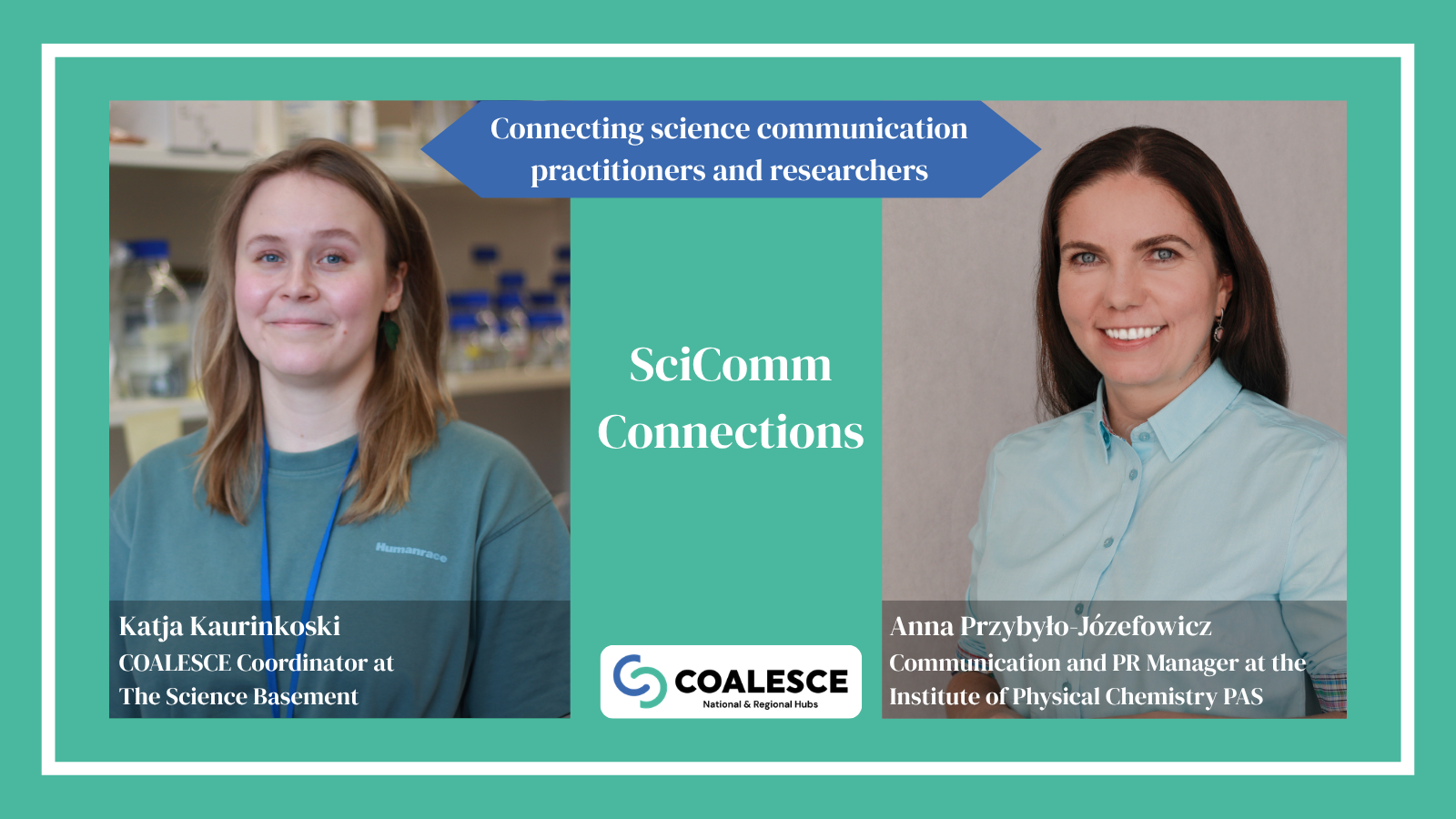
For the second SciComm Connections interviews, we brought together a well-established scientific institute in Poland and a network of early-career researchers from Finland. Most of the people involved in these organisations are STEM researchers, but their involvement as COALESCE Hubs shows how keen they are to improve science communication skills and strategies.
Anna Przybyło-Józefowicz is now the communication and PR manager at the Institute of Physical Chemistry of the Polish Academy of Sciences (IChF PAS), the Polish COALESCE Hub, after previously establishing the communication and PR department at the International Centre for Translational Eye Research (ICTER, also part of IChF). Having so much she wants to learn from COALESCE’s expertise, she is already nervous thinking about what will happen after the project ends in March 2027.
Katja Kaurinkoski, from The Science Basement, the Finnish COALESCE Hub, is just as enthusiastic as Anna about being part of a Hub. She says it has been eye-opening and inspiring to learn about all the projects other Hubs are involved in. By day, Katja is a PhD researcher, but in her spare time she has been chair of The Science Basement (TSB) for three years and is now representing the Finnish Hub.
They are determined to promote science communication among scientists and create innovative approaches to science communication engagement, but they struggle to find the most relevant research in this field. They hope the European Competence Centre for Science Communication will become a go-to place for curated information that is easy to navigate.
What’s the connection between your organisation and science communication research or practice?
[Anna] At the Institute of Physical Chemistry of the Polish Academy of Sciences, we have actively developed communication and PR in the last few years. We were one of the pioneers in Poland in translating hard sciences into more accessible material – 15 years ago, we started producing press notes for the general public based on our most important publications.
At that time, we started a collaboration with a scientific photographer – I think the only one in Poland – who creates an interesting combination of art and science. He puts the scientists in original setups, sometimes dressed in a specific way, using lots of different materials, and in non-intuitive landscapes to convey the core ideas of the accompanying science popularisation article.
[Katja] It’s lovely to hear what your institute is doing, Anna. The Science Basement is a non-profit led by and for early-career researchers to get hands-on experience in science communication in a safe environment. Through our different projects, we try to take science out of the basement – if you allow me to use this fun phrase.
One of our main projects is this Afternoon Talk series where an early-career researcher gives a short 30-minute talk at the largest public library in Helsinki. The public can either go there to attend the talk or just happen to be at the library when the talk takes place, and have the opportunity to ask questions. This is something that the researchers often find rewarding. We also have a podcast, a Youth Science Club and a blog. And we’re currently organising a Science Slam.
If I understand correctly, most of your training is for researchers in STEM areas, or do you have social science researchers as well?
[Katja] We have both, but the majority are in STEM. I think that’s just because of how it started, and members join because their friend is there, you know. It spreads by word of mouth, but we are increasingly trying to reach researchers in the humanities and social sciences.
What about you, Anna? You are promoting the science being done at your institute, but are you engaging scientists in science communication as well? Are you training scientists to do that?
[Anna] Not yet. It is one of our goals as a COALESCE Hub. But scientists are involved, and some are really engaged and passionate about communicating science.
There are a lot of bottom-up initiatives emerging from the research groups. For years now, our scientists have been organising a coffee seminar on Fridays. They gather in the conference room with a speaker from the Institute, from elsewhere in Poland or from abroad, who shares something really cool about their own research in an informal way. It is also open to the general public – we post it on social media. The invitation is designed by one of the organisers, who draws it by hand – she is a scientist but also an artist.
Another example: scientists and administrative staff who have kids are passionate about running workshops for children. They do really cool experiments for kindergarten and primary school pupils, and the kids are super engaged.
We also have a scientist, a lab manager responsible for dissemination at our institute, who regularly runs workshops for high school students. He explains how a chemist sees the world and tries to engage young people in a career as a scientist in chemistry. It’s a bit more advanced, but we have so many bookings that he’s already booked till next year.
We also take part in a large national initiative called the Science Picnic at the National Stadium in Warsaw.
And we are trying to combine art and culture with science to popularise it more effectively. IChF has already published a book for children about visiting an eye doctor, with cool drawings. And now we are working on a new comics project for young people aged 10 to 14 years old, to promote careers in science, explain what it takes to be a good scientist, and show how science can be really cool and change the world.
Does The Science Basement explore innovative ways communicating science, such as through art, comics or theatre?
[Katja] In the past, we had some science and art projects, but since TSB is mostly run by PhD students and postdocs, our activities evolve as people graduate. So the projects change over time.
Do you know the electrical boxes around the city that are usually grey and boring? One of our [former] members, Stephanie Maison, who is an atmospheric scientist, collaborated with some artists to make these beautiful mini murals, and then some larger ones, about the Intergovernmental Panel on Climate Change (IPCC) report and the 1.5oC of warming. And they’re still around the city, even though they were created quite some years ago.
In the science slam – similar to a poetry slam, where poets recite their poems on stage in a passionate way, scientists perform their science, and they are totally free to decide how to do it. Last time we organised it, a science communication researcher sang about her work in an operatic style. That was really phenomenal. We’re organising it again this year, and I’m really looking forward to seeing what creative ideas people will come up with – it would be cool if someone danced their work. The University of Helsinki organises a Dance Your PhD competition, which is always very fun, and many of our members take part.
So, we try different things. One of the most recent is a wonderful virus board game being created by some of our members. Kids like it so much that they want to take it home.
I can see something you have in common: you use the skills and expertise available within your teams or networks to develop initiatives. This means the initiatives can change over time, but also that fresh ideas can emerge. My question now is whether you also turn to research in science communication to help you in any way.
[Katja] I’m a neuroscientist, so I have to admit, I’m not very familiar with science communication literature. As I was preparing for this interview, I asked other members of The Science Basement, and some really interesting points came up. First of all, we don’t really consult the science communication literature that much, to be perfectly honest. We did in the past. For a year or so, we had a science communication journal club. We opened it up to anyone who was interested and had people from outside the organisation coming along. Someone would present a recent research paper on science communication, or we would all go through the same textbook chapter or so, and discuss it there. But since that journal club, we haven’t had many direct interactions with science communication researchers.
After thinking about this, it would be really nice to do it [engage with science communication research]. And there is clearly interest in doing so. A member of The Science Basement mentioned it’s quite hard to tap into the literature when it’s not your field; there’s a lot of jargon and fragmentation. It’s a completely new field to us, and you almost don’t know where to start.
[Anna] I just want to say, Katja, that I absolutely love your initiatives, and I think it’s also inspiring for us to adapt some of these ideas to Poland. I will be thinking about this board game, this movement, this way of expressing science through the voice. I will take it to my director, and I’m sure we can adapt some of it. I just love it.
Anna, do you use science communication research to inform your science communication activities?
[Anna] We are doing it in three ways. First, a decision was taken at the leadership level at our institute a few years ago to really focus on and give science communication a strategic position. We believe it’s really important because, in the end, taxpayers are paying for what we do, and we have a responsibility towards them. And we also really want to explain, illustrate and show the impact of what we do. That’s why the communication manager goes to conferences, to stay up to date with the latest trends in science communication. I was a member of PCST Network for a few years. I am also a member of AEC2, the Spanish science communication association. [Their conference] is, let’s say, more empirical, but based on research, because at the conferences they also present research and what is new.
Second, on the more theoretical side, the directors decided to buy handbooks on science communication. I am now reading them. They’re a little bit of a hard read, also because I’m not a native English speaker, but once I dive into them and work through the difficult words, I really feel that this is something we’re on board with and trying to stay ahead of. Actually, some of the things that are described theoretically, we’re already doing intuitively. And that’s good. I’m also learning new things, of course.
The third way is COALESCE. We are so happy to be a Hub because COALESCE offers a lot of research-based tools. It will help us bring these tools into the Polish context at a more institutional level as well, especially because our director is part of an advisory board developing new evaluation criteria for scientific institutions. And it has been decided that one of the criteria will be science communication.
And the last thing – so it’s four, not three – we try to be an opinion maker in science communication. For example, I published a piece on the London School of Economics Impact blog on narratives about the impact of science. Are we really communicating the impact in a way that people can understand? I suggested some approaches such as creativity, storytelling and the use of examples.
What are the main barriers to incorporating science communication research into your practice?
[Katja] The jargon, as I mentioned earlier, and not knowing where to begin are perhaps the biggest obstacles. We are all early-career researchers, mostly PhD students, juggling this [The Science Basement, TSB] on the side. So time is unfortunately a factor. If there was a place where you could find the latest research, for example, on the COALESCE platform [Competence Centre], it would make a big difference. It would be quicker to find things if everything was in one place. It would also help to have some connections to guide us, at least in the beginning, and to learn from others – how they evaluate, for example. We use feedback questionnaires after the workshops and training we run, and we evaluate our projects every once in a while, but I’m sure we could be doing it better.
[Anna] I agree with Katja. It is a big challenge to find relevant articles and decide which are really useful and applicable to our circumstances. And sometimes I feel that, in this field, the number of citations is not necessarily the criterion we should use to decide whether an article is the best one for us, because we need different things. It’s hard to choose from all the knowledge available.
Another obstacle is that I’m a communication manager at a very big institution with 450 people, which is part of the Polish Academy of Sciences, but I am the only one [in the communication office]. It’s a big responsibility. I have to go through the research in order to translate it into practical guidance for scientists, who are not always engaged in science communication, and maybe only a small percentage of them will use it anyway. This is a challenge. I don’t know how to tackle it.
You mean that this is a lot of work for one person – you – who has to keep up with science communication research and advise scientists on how they should approach science communication?
[Anna] Well, I don’t have to. This is not an expectation. But as we try to maintain high standards, I do it in my free time – but I also have a lot of other things to do. It’s an extra task and it takes a lot of time. It’s fair to say that it might be something that isn’t strictly necessary, but I do think it’s vital and strategic. So it would help a lot to have access to it in a simplified way, maybe through COALESCE.
I see that it can also be difficult to get scientists to see the importance of science communication.
[Anna] Well, we have scientists of all ages. You know, Poland used to be a socialist country, and though it has changed a lot in the last 30–40 years, there are still professors who started working way before that. Young scientists like Katja, and others from her generation, understand and try to engage, but there are many different generations working together. Sometimes you just know that some research groups are led in different ways, and they don’t focus on science communication, and that’s okay. We try to do the best with the resources we have and the scientists who want to engage with science communication.
If you could ask science communication researchers to focus on something that would help your work, what would it be? What kind of research would be most useful to you?
[Anna] I have something that I have been thinking about for a couple of years and that I have already asked Joana Magalhães [co-coordinator of COALESCE]: Are there any templates or guidelines for creating a science communication strategy for an institution? She said not yet. I would like to have empirical evidence on what makes a good science communication strategy – a step-by-step strategy for a year or more, with tools, guidelines, statistics, data, etc. This would be so amazing.
[Katja] This is a very difficult question and I’m not sure that I have a direct answer right now. It would be nice to have forums – perhaps they already exist and I’m not aware of them – where science communication practitioners and science communication researchers could meet. Maybe science communication conferences are where this happens, but I would like to have more of these opportunities to talk about what works in practice and then reflect on how that connects with theory.
Would you like to be part of a science communication research project? What do you think you could contribute, and what kind of project would you be interested in taking part in?
[Anna] We are not participating yet, but we would like to. We are open to various topics. The strategy topic is especially close to my heart, if there is any research going on in that area. Also important is what we can offer: we have a really big platform to test out solutions, even at the pilot level. At the Institute, we have 30 research groups and many labs, and the Polish Academy of Sciences, of which we are part, has 69 institutes.
[Katja] TSB is not participating either, but we would be delighted to join. In your invitation for the interview, when you asked for ideas to improve the relationship between practitioners and researchers in science communication, I thought of exactly this: bringing practitioners into research, into ongoing studies. For example, researchers could pick one of our projects – the afternoon talks, the podcast, the youth science club – and see whether it is really serving the purpose we think it does. Are we really reaching our audiences as effectively as we could? For the youth science club, it would be good to look at it from a pedagogical angle, for example.
Another way TSB could be involved in science communication research would be around training materials, given that we are training people. It could be really nice to see how effective the training is and the difference it makes for people from different backgrounds.