SciComm Connections: “Researchers need to pay more attention to the problems identified by practitioners”
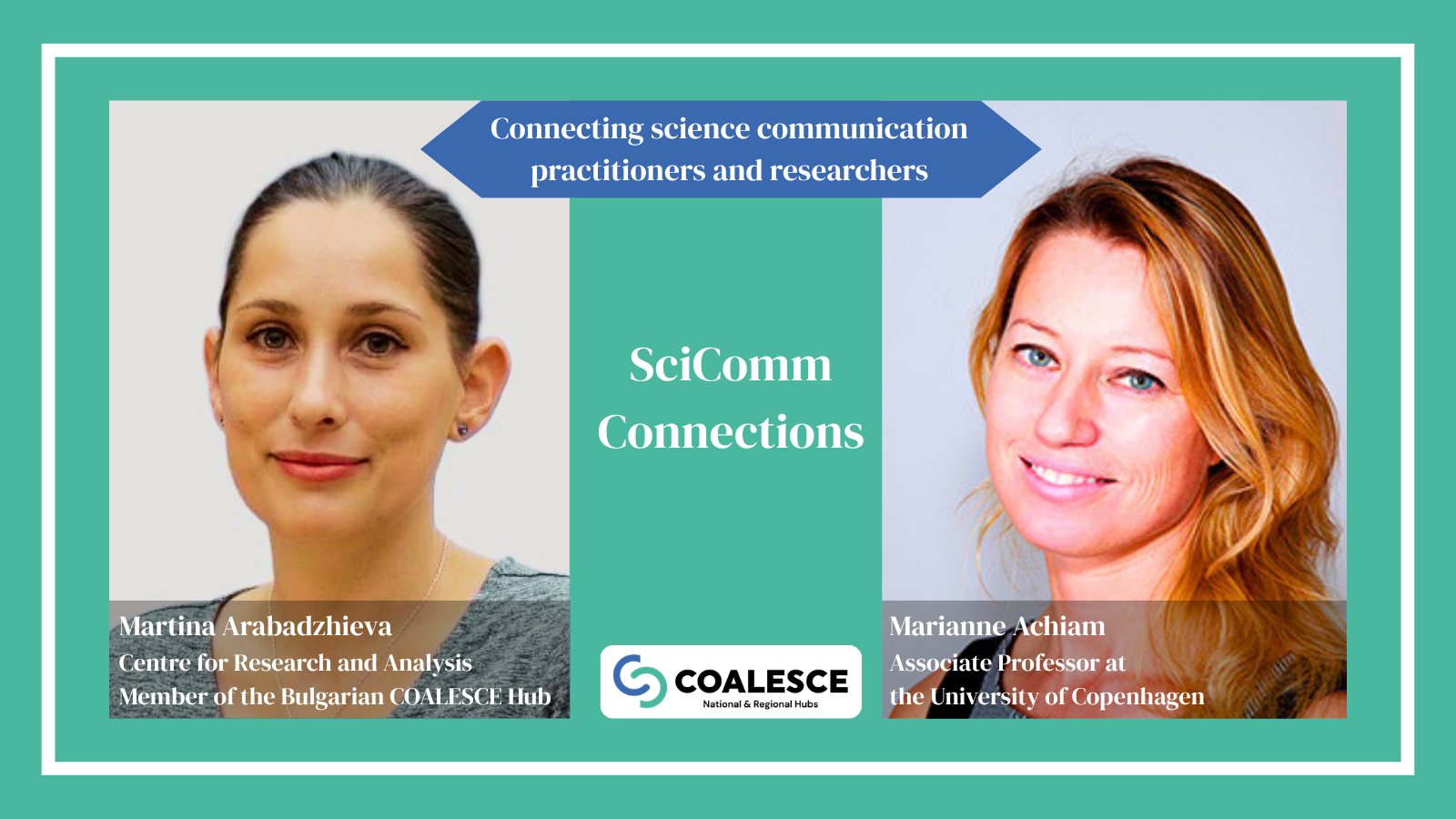
Martina Arabadzhieva represents the Bulgarian Hub and is part of the Centre for Research and Analysis (CRA). The Bulgarian Hub includes several organisations – CRA, Beautiful Science Foundation, Forum Democritus and Muzeiko. On the other side of the virtual room sits Marianne Achiam, who leads a research group of four people in science communication at the University of Copenhagen in Denmark. COALESCE is in the middle, acting as a bridge in this paired interview series, where practitioners connect with researchers.
The CRA, led by Prof. Albena Vutsova, has a 20-year history in various educational and research projects and aims to promote training and science communication. One of their most active members is Lyubov Kostova, whom Martina describes as “the pioneer of science communication in Bulgaria”. Lyubov Kostova is a representative of the Beautiful Science Foundation, which organises science festivals all over Bulgaria. Part of this Hub is also the children’s science museum, Muzeiko, which is the first of its kind in Bulgaria.
Two thousand kilometres away in Copenhagen, Marianne’s group conducts research in science communication and teaches STEM students at the university. It’s through this link with education that the team tries to connect research and practice in science communication. Additionally, Marianne Achiam is a member of the Scientific Committee of the European Environmental Agency, where she provides her expertise in science communication, and the chair of the Committee on Science Communication and Dialogue of the Novo Nordisk Foundation. “Even though we are a research group and we’re located in a kind of ivory tower that is the university, we really try to make our research insights work in practice,” says Marianne. “We also take an interest in science communication practice, in what’s going on out there, and how we can learn from that.”
Connections between research in science communication and practice are at the core of this conversation. Can you give me concrete examples of what is working (or not) in this relationship, both transferring research into practice and incorporating practitioners’ knowledge into your research?
[Marianne] The most pertinent example is a research programme I’m running right now with funding from the Novo Nordisk Foundation, where we are co-developing and co-implementing a series of science communication experiments. The idea is to provide research-based insights on how to conduct good science communication that supports sustainable, pro-environmental behaviours.
So, rather than thinking about how we would do that at the university and then trying to implement it somewhere, we really made a big deal of bringing together multidisciplinary teams in three institutions. In each place, we had a curator, a science communicator, an artist and a scientist to develop ideas for science communication experiments. Those experiments involved quite a bit of co-creation with audiences. It was really important for us to connect research and practice in many different ways. Now, we have a ton of data from those experiments we need to sift through, but that’s a good example of how we would do it.
Martina, is your science communication practice connected (or not) with the research in science communication, in your country or elsewhere?
[Martina] Well, I just want to make a quick note to give you a better idea of the state of science communication in Bulgaria. We have people who specialise in it – I’m happy to work with some of them – and many organisations practise science communication. But we don’t have a national strategy or priorities set on a national level.
What we do – the Hub and the organisations included in it – is participate in science communication projects, such as the European Researchers’ Night. It is a priority for our organisation. We are part of the higher education system as well, so no matter what kind of research projects we are working on, we try to organise meetings that are not only for partners and specialists but also for the general public.
If you don’t have a national strategy, where do you get your insights for science communication activities? Are you looking for examples from around the world? What would you like to have to make your work easier?
[Martina] I spend a lot of time searching the university library, but I am always looking for more information. At this point, I would say we need everything, as there are different aspects.
We have experience engaging students and wider audiences in a fun, informal way. However, when it comes to science journalism, there are still very few people doing it well. That’s why we were happy about the journalist guide [provided by the Competence Centre “How to Communicate Science in Times of Crisis? A Friendly Guide for Journalists”]. For different projects, we try to arrange meetings between journalists and experts, so journalists don’t resort only to the three very popular scientists in the country who answer every question on any topic. We are looking for ways to engage and promote science journalism.
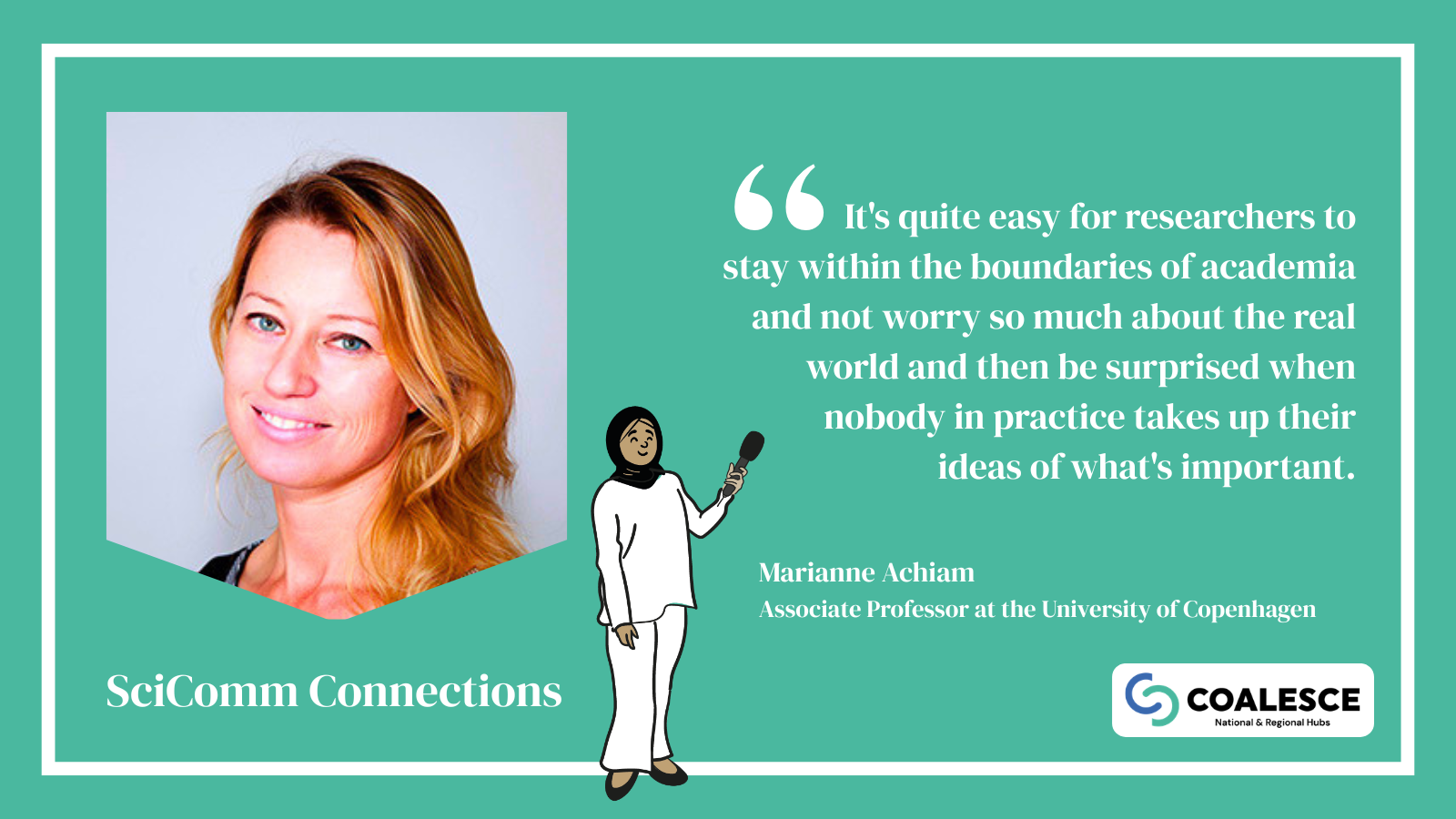
Marianne, you work across research, training and science communication. Where would you recommend practitioners to look for information, training and advice?
[Marianne] I hear a lot of what you’re saying about this, Martina. It’s actually not that easy for practitioners to find research-based information or even practice-informed collected information.
I also applaud the COALESCE initiative and the resources that are made available and will be made available there. The latest Horizon programme funded – I think – eight major science communication research projects, which provided some good resources.
It’s probably a bit problematic to say this, but sometimes these EU projects produce really good resources that don’t always reach wider audiences, right? So, it’s not that easy to find them – though I think those are probably still available somewhere [“CORDIS results pack on science communication”]. Other than that, a lot of the resources we use are research-based articles, but these are often behind paywalls. I can mention the Journal of Science Communication, which is open access and a really nice journal – it’s very easy to access, and the editors make a big deal of highlighting the practical implications of research. I think that’s an important resource.
Also, we’ve tried to hold what we call network meetings, which are events with people who have identified themselves as being interested in our research programme, and it has been a mixed success. Sometimes people will show up online or in person, sometimes they won’t. We are certainly not perfect at targeting our preferred or intended audiences, but some of these events are good for getting new ideas.
Are those events open to everyone? If Martina wanted to attend, would it be possible?
[Marianne]Yes, absolutely. We usually post them on LinkedIn.
Marianne just presented important barriers to access: it doesn’t mean research isn’t done, but maybe it’s not that easy to find. What other barriers do you think science communication practitioners face, Martina?
[Martina] Well, the lack of journalists.
Also, to be honest, academics don’t always make information about their research easily available or understandable.
We connect with society in different ways, events or projects, but that’s not sustainable.
Do you mean that there’s no continuity in time?
[Martina] There is continuity, but it comes through one project and then another. We don’t have anything like the Competence Centre, for example.
Marianne, do you think there is some kind of misunderstanding between the researchers in science communication and the practitioners? Do you see any way this could be improved?
[Marianne]From my perspective – meaning, from the Danish context, I get the sense that science communication is not really appreciated at the institutional and policy levels as a research field, not as something that needs to be understood more in depth. Science communication is often seen as something anyone can do, and if you’re not able to do it, just watch a YouTube video or something like that. It’s a triangle of problems: science communication isn’t taken seriously as a separate field of study. That means researchers aren’t really appreciated for what they do, and, in turn, they don’t really care about practitioners.
Martina, does that reflect the situation in Bulgaria as well?
[Martina] For sure. Science communication is not appreciated at the policy and institutional level in Bulgaria, especially at this moment. I think that practitioners are not even looking at academia for answers. But I remain optimistic.
What would you like the research in science communication to address to help you in your practice? Any question you haven’t found an answer for?
[Martina]Maybe starting from the simplest side: which channels are most effective for reaching wider audiences? How can we reach institutions and policymakers to engage them in this process and receive credible support from them?
Those are challenging questions. Don’t you think, Marianne?
[Marianne] Yes, I agree. Those are very practical and applied questions; they are a good example of what’s useful. And one of the ways research and practice can come together is to get at what’s behind those kinds of questions, really trying to understand the more foundational sort of questions, reflections or needs that might be present in the world of practice.
I have a final question for you both. You mentioned the COALESCE network and resources are helpful for both practitioners and researchers in science communication, but do you have any suggestions on how we can foster these connections? And what are your expectations for the Competence Centre?
[Marianne]I could mention something I think works quite well: the annual ECSITE conference. ECSITE is a network for science centres and museums in Europe, and the conference is really interesting because it’s mostly practitioners. I feel quite privileged to be a researcher there because there’s so much practice to observe, hear and learn from. I really like the idea of putting research and practice together in this way, making events attractive to both parties. Also, the conference sessions are collaborations between people from different countries. So people are kind of ‘forced’, in a positive way, to work together and think about what would be the important discussions to have within the community.
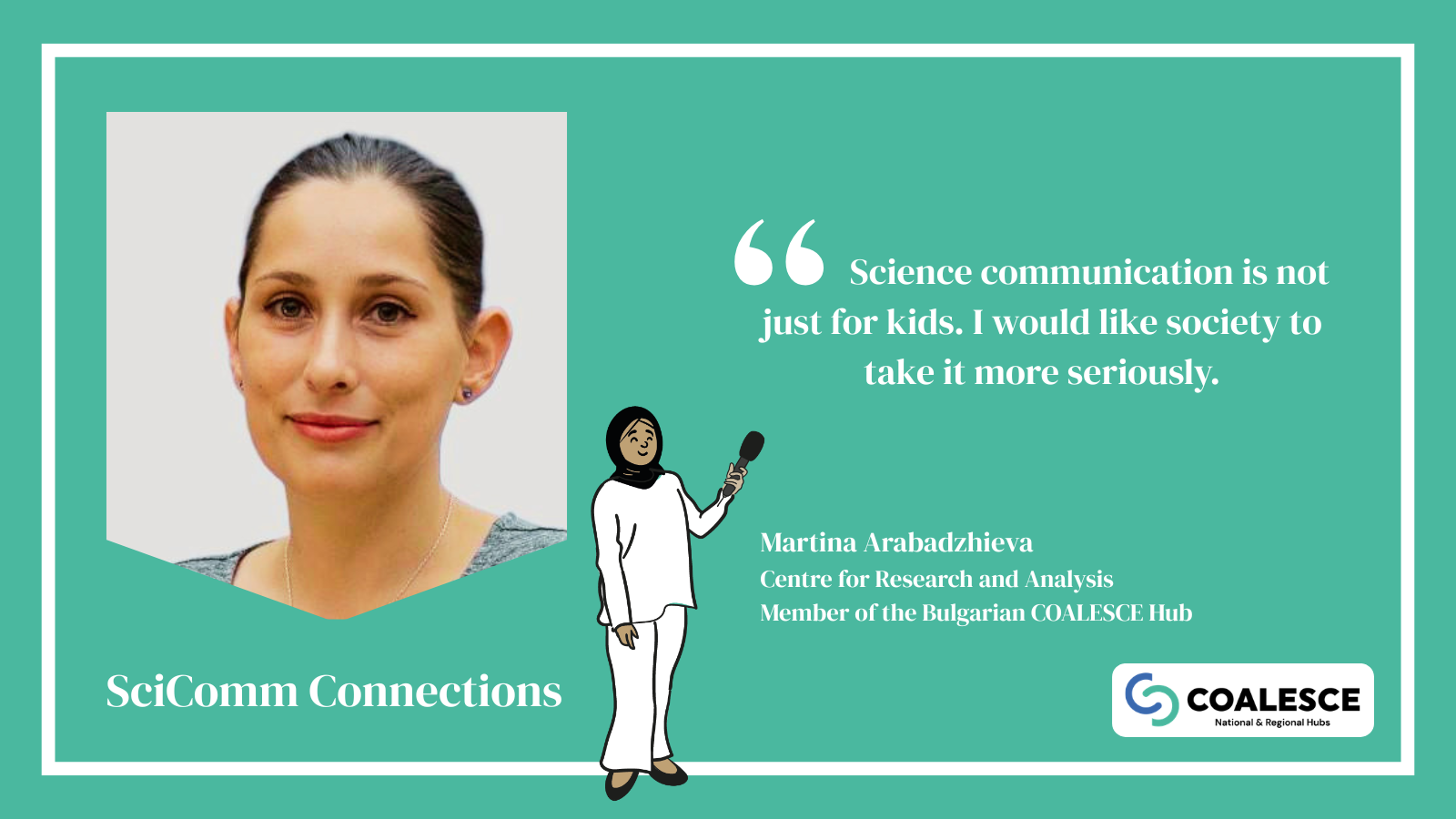
Events are the first natural solution to connect practitioners and academia. And again, moving forward and having institutional support. Science communication is not just for kids. I would like society to take it more seriously.
From COALESCE, any report or recommendations are useful starting points for discussions.
The way you interacted during this conversation was also a good starting point. Do you have any additional remarks?
[Marianne] Just a final remark. Right now, in the European context, there’s a lot of discussion about innovation and how Europe is falling behind the United States and China. There have also been a few recent reports highlighting the importance of scientific knowledge for innovation in Europe.
Enrico Letta [President of the Jacques Delors Institute and former Prime Minister of Italy] talks about the fifth freedom: the free movement of knowledge through layers of society. All of this is to say that I think this is a particularly important moment for science communication, for opening up these knowledge pathways – or even highways – between different levels of society. So this is a really good time for COALESCE to make a mark, bringing together all these important people to discuss these issues from an international European perspective.
Suggested readings by Marianne Achiam
Achiam, M., Grünfeld, M., Vitting-Seerup, S., Jensen, J. T. and Whiteley, L. (2025). Towards a terroir approach to science communication and its evidencing JCOM 24(07), Y01. https://doi.org/10.22323/161120251104104659
Achiam, M., Vitting-Seerup, S., Whiteley, L. and Dam, S. L. (2024). Creating resonance with arts-based approaches to sustainability science communication JCOM 23(06), N01. https://doi.org/10.22323/2.23060801
Achiam, M., Vitting-Seerup, S., Hurley, M., Micallef Grimaud, C., Chanay, R., Eric, D. L., Laursen, S., Dunets, V. and Russo, P. (2026). Practical rationales for art-science in science communication. International Journal of Science Education, Part B, 16(1), 57–70. https://doi.org/10.1080/21548455.2025.2523572