SciComm Collections bring together curated resources on misinformation, impact evaluation, equity and communication in times of crisis

How many times have you asked: “Where can I find reliable guidance on science communication?” The European Competence Centre for Science Communication has made it that easy. Following the release of the SciComm Toolbox, the SciComm Collections bring together high-quality resources supporting science communication work in one place.
The Competence Centre’s SciComm Collections are a one-stop source of important publications and resources related to specific topics relevant to science communication such as misinformation, evaluation of impact, gender and equity and science communication in times of crisis. SciComm Collections features a search engine that allows visitors to search for resources by topic.
With so many documents and so much multimedia content being published about each of these topics, each Collection does not seek to simply list every resource available. Instead, leading experts in the relevant fields have carefully curated the resources to ensure they are contemporary and high-quality. To ensure easy access to the resources, these are either provided on the platform itself or can be accessed via a hyperlink to external sources.
“The SciComm Collections are a part of the SciComm Toolbox. If the SciComm Toolbox is like a library, then the Collections are shelves that cover a specific topic,” says Charlotte Bruns, a Postdoctoral Researcher and Lecturer at Erasmus University Rotterdam and one of the SciComm Toolbox Chief Curators.
Registered Competence Centre users can submit a resource within the platform and suggest that it becomes part of a SciComm Collection, or simply save them on your profile, under ‘my favourites’. This might include toolkits, best practice guides, games, reports, or audio-visual resources you would like to share. You can upload and submit your resource to a curation process here. If you have any questions, check our Frequently Asked Questions or follow our guide “Upload resources step-by-step”.
When uploading materials, you can classify them as Foundational, Intermediate, Advanced, or Expert – much like we do with our training – and mention who your target audience is, such as communicators, journalists, researchers, teachers, or members of the public. Adding this kind of information makes it a lot easier for anyone interested to find the right resources for them.
SciComm Curatathons to work through tons of resources
To support the live curation of SciComm Collections, the Competence Centre launched SciComm Curatathons.
A Curatathon is a collaborative, community-driven event inspired by Wikimedia editathons. It brings together reviewer volunteers to quality-curate science communication resources related to specific topics that will be featured in future SciComm Collections. The topics selected so far for the Collections are based on end users’ preferences and other emerging hot topics for effective science communication.
Before each Curatathon, an open call will be launched for submissions of resources that relate to each of the SciComm Collection and registered users will be invited to upload resources. After that, users who have signed up to become reviewers will be invited to come together during a collaborative event to discuss the latest trends in the topic and curate resources.
During each Curatathon, participants focus on reviewing a high volume of science communication resources. Volunteers will follow the Principles, Standards and Criteria established by the project to assess content, edit metadata, and tag it to ensure quality and relevance for end users on the platform.
During the next months, the team plans to run curatathons for the upcoming thematic SciComm collections, such as one on gender and equity, and another on science communication for policy.
Navigate the SciComm Collections
- Misinformation and Trust
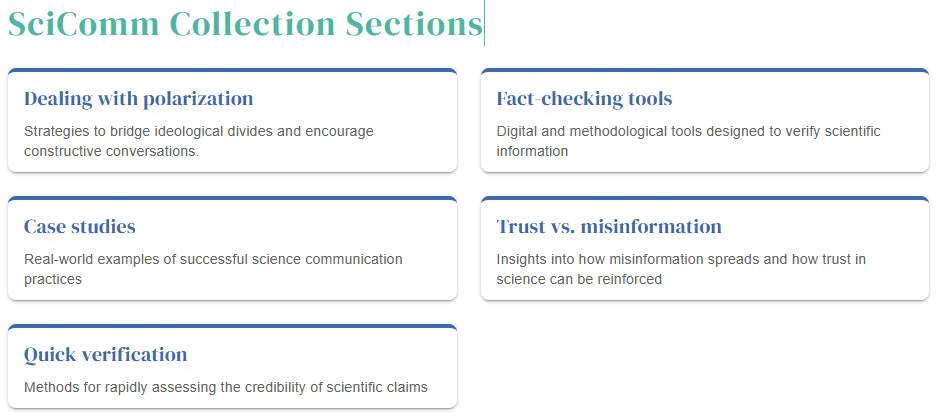
The Misinformation SciComm Collection focuses on strategies to address misinformation and trust, ensuring that accurate scientific information remains accessible and credible. By examining various approaches within the field, this collection provides practical insights into reinforcing trust in scientific institutions and expertise while mitigating the impact of dis- and misinformation and fake news. collection you can find reports, books, toolkits, and more resources that allow for effectively countering misinformation and engaging diverse audiences.
- Evaluation and Impact
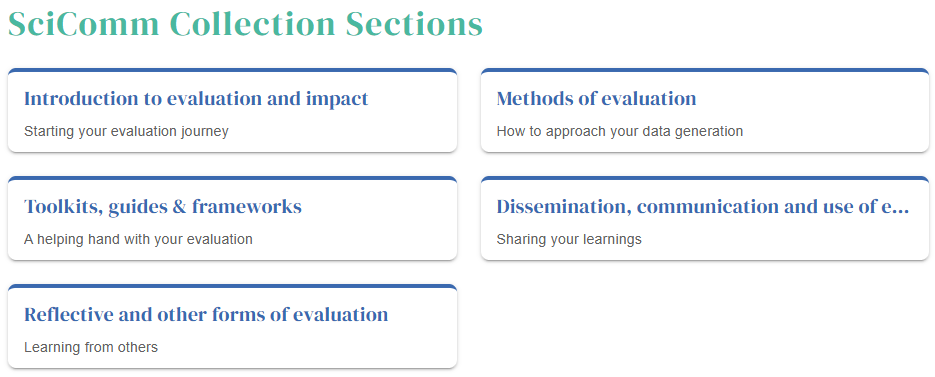
In the Evaluation and Impact SciComm Collection you can find information and guidance about impact and evaluation for science communication and public engagement. While tracking short-term outputs is useful, understanding the broader societal effects of science communication helps position the field and its actors as influential changemakers in policy, research, and innovation. The types of resources listed include publications discussing evidence-based theories, frameworks and tools to support impact assessment; guidebooks supporting evaluation framework design; toolkits highlighting a variety of evaluation instruments suited to a large range of activities; platforms dedicated to science communication impact and evaluation.
- Use of AI for Science Communication
The co-creation work to create the SciComm Collection on the Use of AI for Science Communication is still in progress. This collection will bring together practical resources on using AI in science communication. Each section will offer a curated collection of tools, handbooks, guides, frameworks, and key papers. The materials are designed for users working with diverse audiences, including communication officers, policymakers, researchers, and journalists.