|
scicommcentre.eu Newsletter #7: September 2026 |
View online
|
| |
|
SciComm Toolbox, your quality-check resources |
|
While the COALESCE project is entering its final six months, work on the European Competence Centre for Science Communication is far from over.
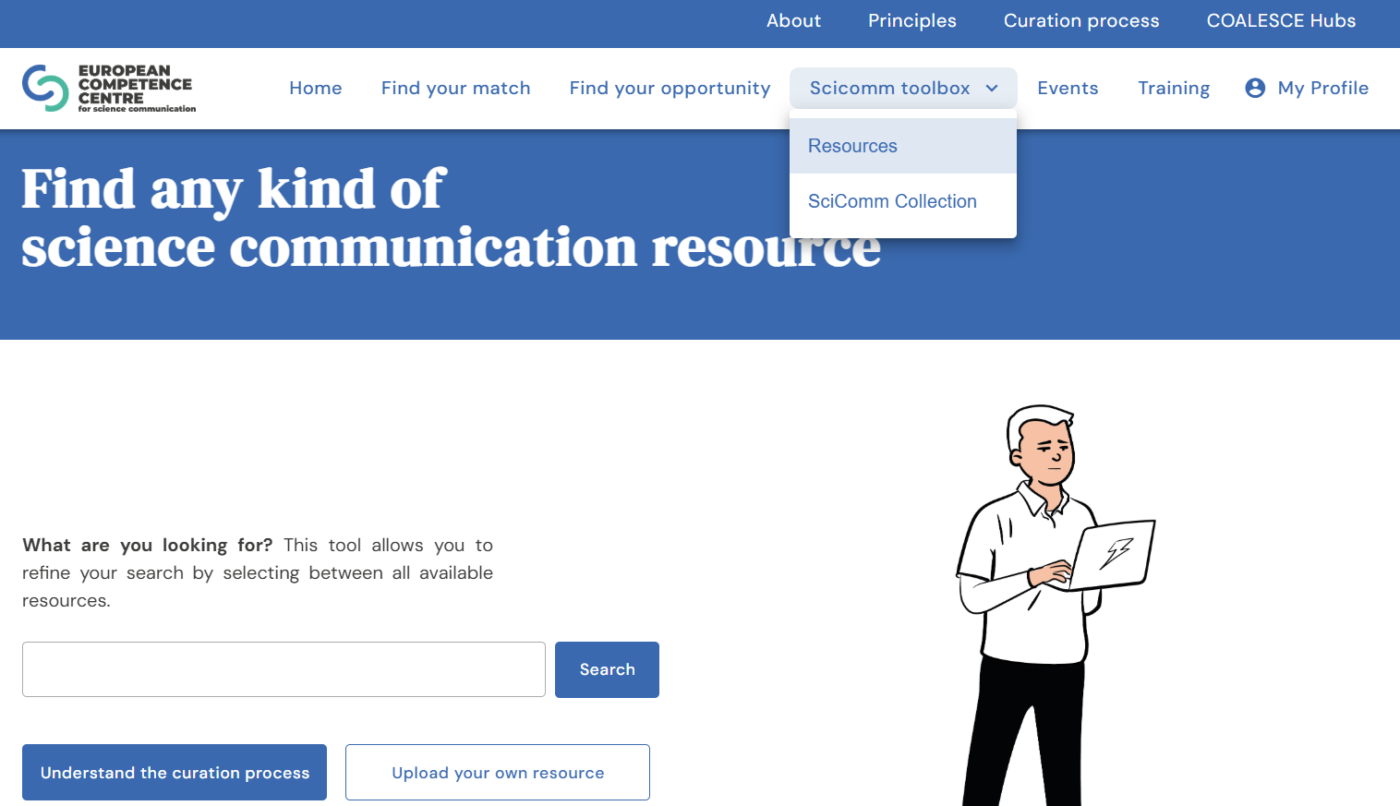
If you haven’t signed up to the Competence Centre yet, now is the time – you’ll be amazed at what you can already find there. You can share opportunities, invite people to join your projects, and you can find training and conferences, among other things. We have already made the first part of our curated science communication library available. The SciComm Toolbox is a searchable library of high-quality resources designed to support anyone communicating science.
As well as resources, science communicators also need competences. But what kind of skills and knowledge do the different types of science communicators currently need? The Science Communication Competence Framework aims to address this, and you can take part in the validation process. Find out how below.
Finally, if you are a COALESCE Hub you won’t want to miss our annual meeting and final Mutual Learning Exercise in Science Communication in Research and Innovation, both taking place in Dublin, Ireland, at the end of October.
– The COALESCE communications team –
|
| |
|
Competence Centre Spotlight
|
| |
|
Curated library of high-quality resources launched to support science communicators across Europe
|
| |
|
A library of high-quality resources providing guidance, ideas and insights to anyone who communicates science has been released on the online European Competence Centre for Science Communication.
The SciComm Toolbox is a searchable library of guides, reports, and materials curated and quality-checked by volunteer reviewers under the coordination of an appointed Curation Board, managed by team members from the COALESCE project.
Resources currently available in the toolbox include a short guide to developing videos communicating science, informed by insights from an innovative experimental video ‘Kurzgesagt – In a Nutshell’, a short report on how citizen science can be a means to tackle misinformation, and a guide to quality criteria for online science communication. But there are many more.
These resources were developed within projects funded by the European Union’s Horizon 2020 program Science With and For Society (Swafs-19), including TRESCA, NEWSERA and ENJOI, as well as within COALESCE. In the future, it is planned for the toolbox to expand. |
| |
SciComm Lunchtime Series
Promoting the dialogue on complex, controversial issues. The discussion games 🔗
📅 14 October 2026 | 12:30-14:30 CET
🎓 Intermediate
🗣 Paola Rodari, Sissa Medialab
🎫 Register here
Communicate to policymakers 🔗
📅 11 November 2026 | 12:30-14:30 CET
🎓 Intermediate
🗣 Joana Magalhães, Science for Change
🎫 Registration will open soon
Science communication in times of crisis 🔗
📅 16 December 2026 | 12:30-14:30 CET
🎓 Intermediate
🗣 Elisabetta Tola, Formicablu & Paola Rodari, SISSA Medialab
🎫 Registration will open soon |
| |
|
Time for a European Competence Framework for Science Communication Professionals
|
| |
|
What does it look like to be a science communication professional in Europe? What kind of skills and knowledge do different types of science communicators currently need? And how will those skills and that knowledge need to have changed in 10 years' time? Those were the provocative questions asked during the first minutes of the fourth topic online session in a series of Mutual Learning Exercises (MLE) on Science Communication in Research and Innovation, organised by COALESCE.
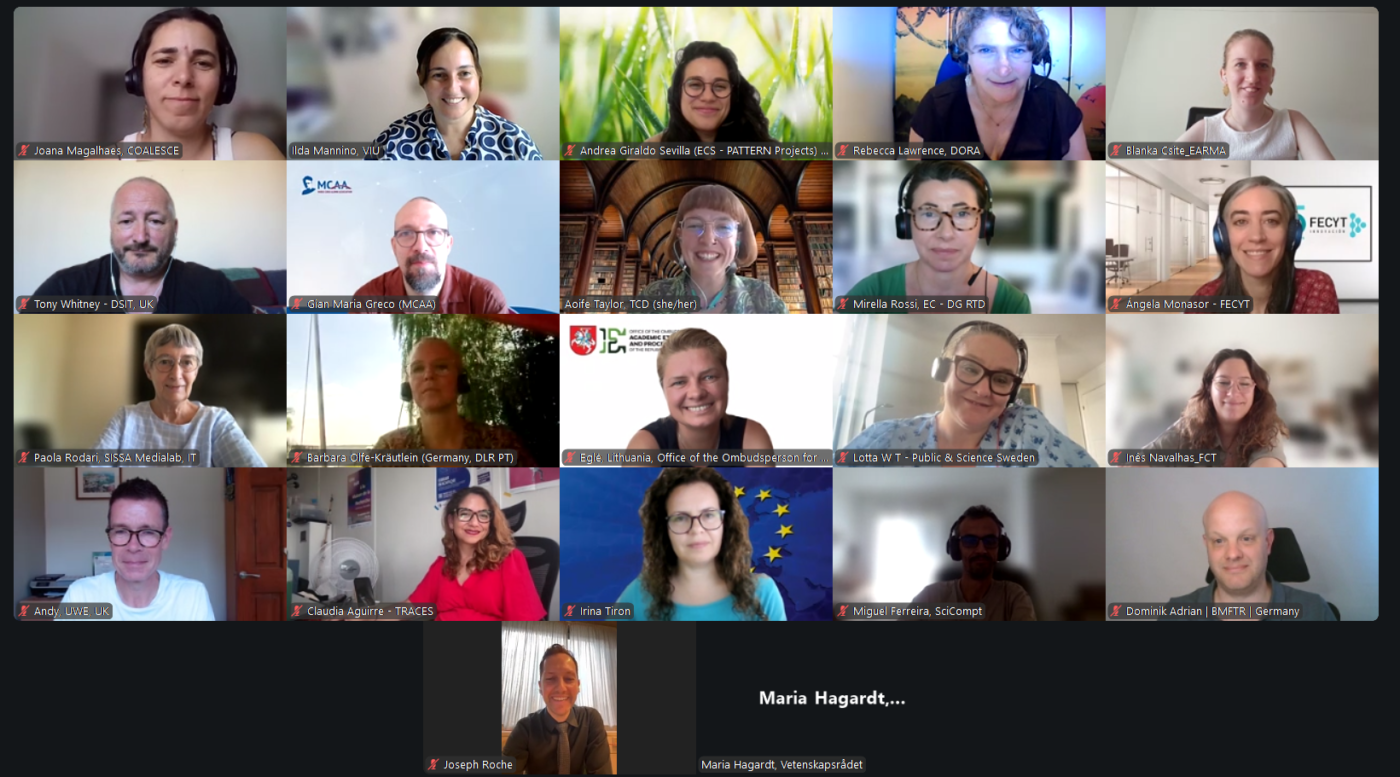
As with previous MLE sessions, the goal was to bring together European Research Area (ERA) member state representatives to discuss policy challenges and opportunities to support science communication. The meeting welcomed participants from France, Germany, Ireland, Italy, Lithuania, Portugal, Spain, Sweden and the UK.
Under the topic “Building skills and competences – towards a science communication competence framework”, participants in the MLE on 25 June were invited into a participatory exercise aimed at understanding professionalisation paths in science communication, learning about strategies for training and capacity building, fostering reward and recognition in science communication careers, and supporting the inclusion of science communication in local and national strategies.
Group discussions were preceded by a roundtable with Gian Maria Greco, outgoing Chair of the Marie Curie Alumni Association (MCAA); Rebecca Lawrence, vice-chair of the Declaration On Research Assessment (DORA); Blanka Csite, Policy and Project Officer at the European Association Research Managers and Administrators (EARMA); and Andrea Giraldo Sevilla, Research Manager at the European Citizen Science Project (ECS). |
| |
|
SciComm Competence Framework: Museums, Science Centres and informal learning providers
|
| |
|
As the COALESCE team develops the Science Communication Competence Framework, it is targeting different audiences to support their self-evaluation and professional development. One of such group is the staff working in museums, science centres, and other informal learning providers.
After discussing the framework with various stakeholders, the final step is to validate it on a wider scale using a short survey. If you are an expert in this area – museums, science centres, or other informal learning organisations –, please indicate whether the competences identified in our earlier work are relevant to the field, and whether they have been allocated to the correct level (Foundational, Intermediate, Advanced or Expert). You can also suggest any missing competencies.
The survey will be open until 15 November. Please feel free to share it with colleagues in this field. |
| |
|
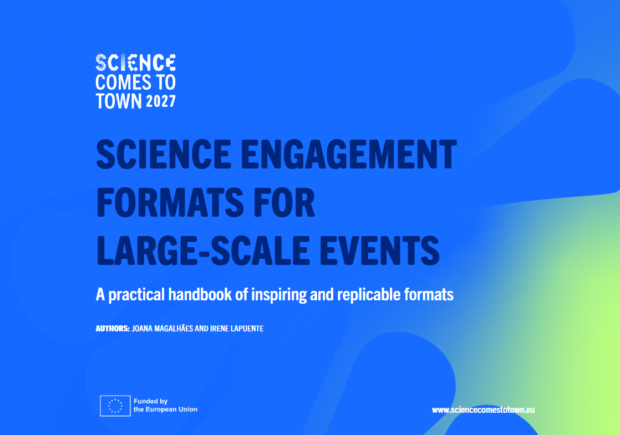
Science Engagement Formats for Large-Scale Events – A Practical Handbook of Inspiring and Replicable Formats |
|
This handbook is intended for organisers of large-scale public engagement events and provides inspiration and practical guidance on three types of activity: (i) dissemination, (ii) dialogue and engagement, and (iii) participatory and citizen science.
The handbook was created under the Science4everyone project, which will deliver Sciences Comes to Town – a flagship initiative from the European Commission – in 2027, in Oeiras, Kaunas, Genova and Aarhus. A call for contributions was promoted under the European Competence Centre for Science Communication – COALESCE project. |
|
|
| |
|
SciComm Connections: bringing practitioners into science communication research
|
| |
|
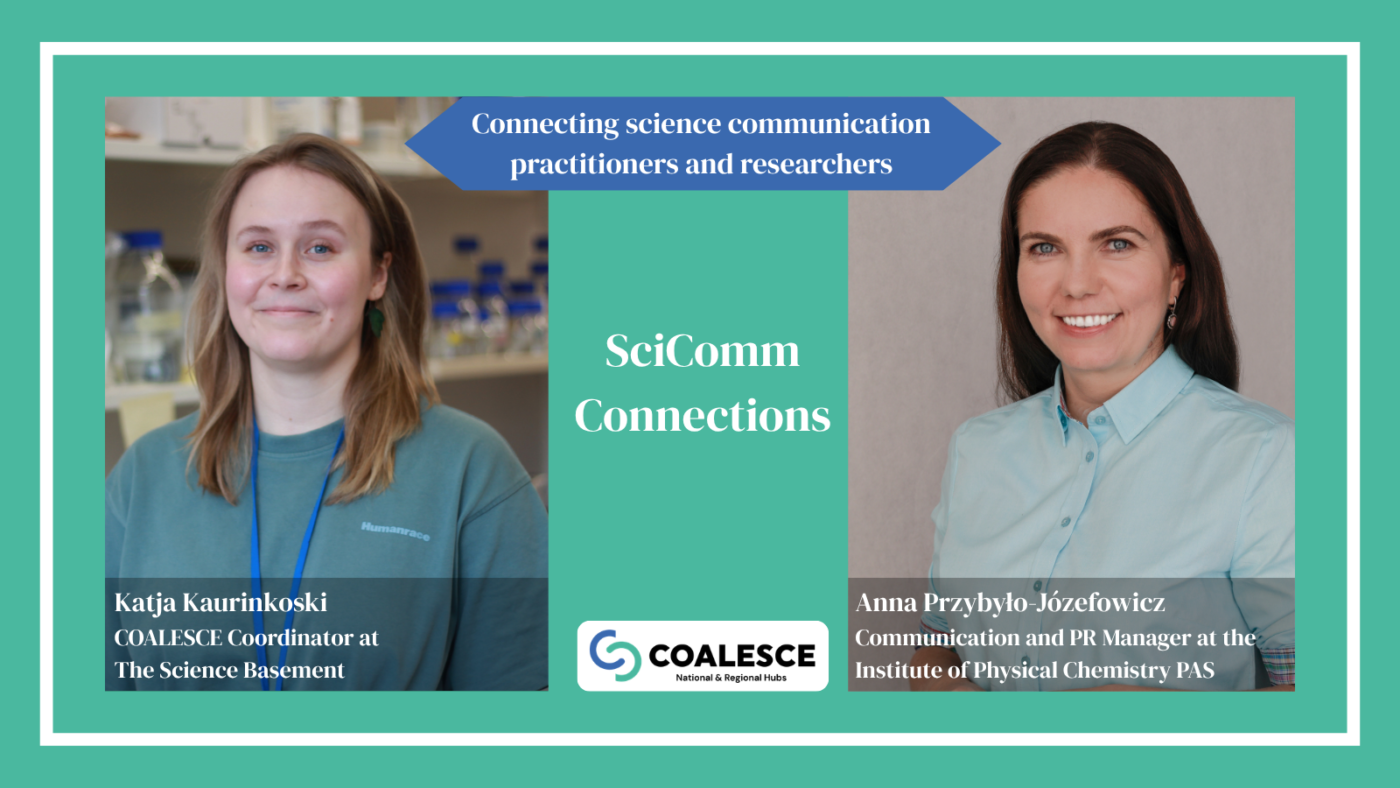
For the second SciComm Connections interview, we brought together a well-established scientific institute in Poland and a network of early-career researchers from Finland. Anna Przybyło-Józefowicz is now the communication and PR manager at the Institute of Physical Chemistry of the Polish Academy of Sciences (IChF PAS), the Polish COALESCE Hub. Katja Kaurinkoski, from The Science Basement, the Finnish COALESCE Hub, is just as enthusiastic as Anna about being part of a Hub. She says it has been eye-opening and inspiring to learn about all the projects other Hubs are involved in.
[Excerpt of the interview]
Would you like to be part of a science communication research project? What do you think you could contribute, and what kind of project would you be interested in taking part in?
[Anna] We are not participating yet, but we would like to. We are open to various topics. The strategy topic is especially close to my heart, if there is any research going on in that area. Also important is what we can offer: we have a really big platform to test out solutions, even at the pilot level. At the Institute, we have 30 research groups and many labs, and the Polish Academy of Sciences, of which we are part, has 69 institutes.
[Katja] TSB is not participating either, but we would be delighted to join. In your invitation for the interview, when you asked for ideas to improve the relationship between practitioners and researchers in science communication, I thought of exactly this: bringing practitioners into research, into ongoing studies. For example, researchers could pick one of our projects – the afternoon talks, the podcast, the youth science club – and see whether it is really serving the purpose we think it does. Are we really reaching our audiences as effectively as we could? For the youth science club, it would be good to look at it from a pedagogical angle, for example.
Another way TSB could be involved in science communication research would be around training materials, given that we are training people. It could be really nice to see how effective the training is and the difference it makes for people from different backgrounds. |
| |
|
If science is global, science communication cannot be local
|
| |
|
Opinion article by Anna Przybylo-Józefowicz, communication and PR manager at the Institute of Physical Chemistry, Polish Academy of Sciences, and coordinator of the Polish Hub within the COALESCE project. First published by University World News on 8 July 2026.
Science has become global. Science communication has not.
Scientific research is increasingly borderless. Breakthroughs emerge from international collaborations, cross-border funding and multinational teams. Yet a striking paradox lies at the heart of modern science: while knowledge production is profoundly international, the structures responsible for communicating its societal value remain local, culturally conditioned and institutionally siloed.
Research systems have long recognised mobility as a driver of excellence. Researchers routinely travel and benefit from exchange programmes. Yet the same logic is rarely applied to the professional communities supporting them. While institutions invest heavily in researcher mobility, opportunities for science communication professionals to learn from peers abroad remain limited and informal. |
| |
|
Upcoming events |
AI Hype, Hope and Humanity Festival
📅 30 September to 2 October 2026
📍 Rotterdam, Netherlands
🗣 English
🎫 Register here
The 'AI Hype, Hope and Humanity Festival' examines how artificial intelligence is transforming society and how it can be shaped responsibly. Through discussions, workshops, demonstrations, academic sessions, creative activities, showcases, and a startup competition, the programme explores AI’s impact across key sectors while highlighting practical solutions, innovation, education, and the skills needed for long-term change. More…
__ __ __
PCST Berlin Symposium 2026
📅 5-6 October 2026
📍Berlin, Germany
🗣 English
PCST Berlin Symposium 2026: Building Knowledge Together: Citizen Science, Communication, and Trust is an international symposium that explores how participation in science and science communication can shape trust. Bringing together researchers and practitioners, the event provides a space to examine citizen science as a pathway for collaboration, dialogue, and shared knowledge production. Through theoretical, empirical, and practical perspectives, participants will discuss how transparency, reciprocity, communication, and long-term engagement can help strengthen relationships between science and society. More…
__ __ __
EUFIC Annual Conference & 30th Anniversary Celebration
📅 8 October 2026
📍 Brussels, Belgium
🗣 English
🎫 Register here
Under the theme “Misinformation on Food and Health: Building Shared Responsibility and Action”, the event will explore how misinformation emerges and spreads, its impact on public trust and health outcomes, and the role of digital platforms and AI in accelerating these challenges. EUFIC will also present its new seven-year strategy and position on tackling food and health misinformation. More…
__ __ __
Wisskomm Connected 2026
📅 21–22 October 2026
📍 Berlin, Germany
🗣 German
Wisskomm Connected 2026 is a free conference that strengthens exchange between research and practice in science communication. The event provides a space to discuss current challenges such as polarisation, disinformation, changing media environments, artificial intelligence, participation, institutional responsibilities, and the role and limits of science communication. Through different interactive and discussion-based formats, participants share experiences and explore how the field can remain robust, diverse, and responsive to societal change. More…
__ __ __
Visit the Competence Centre events page for more conferences, opportunities, training and other events. Do you want to announce your event or conference? Please contact us.
|
| |
|