COALESCE project welcomes five new hubs
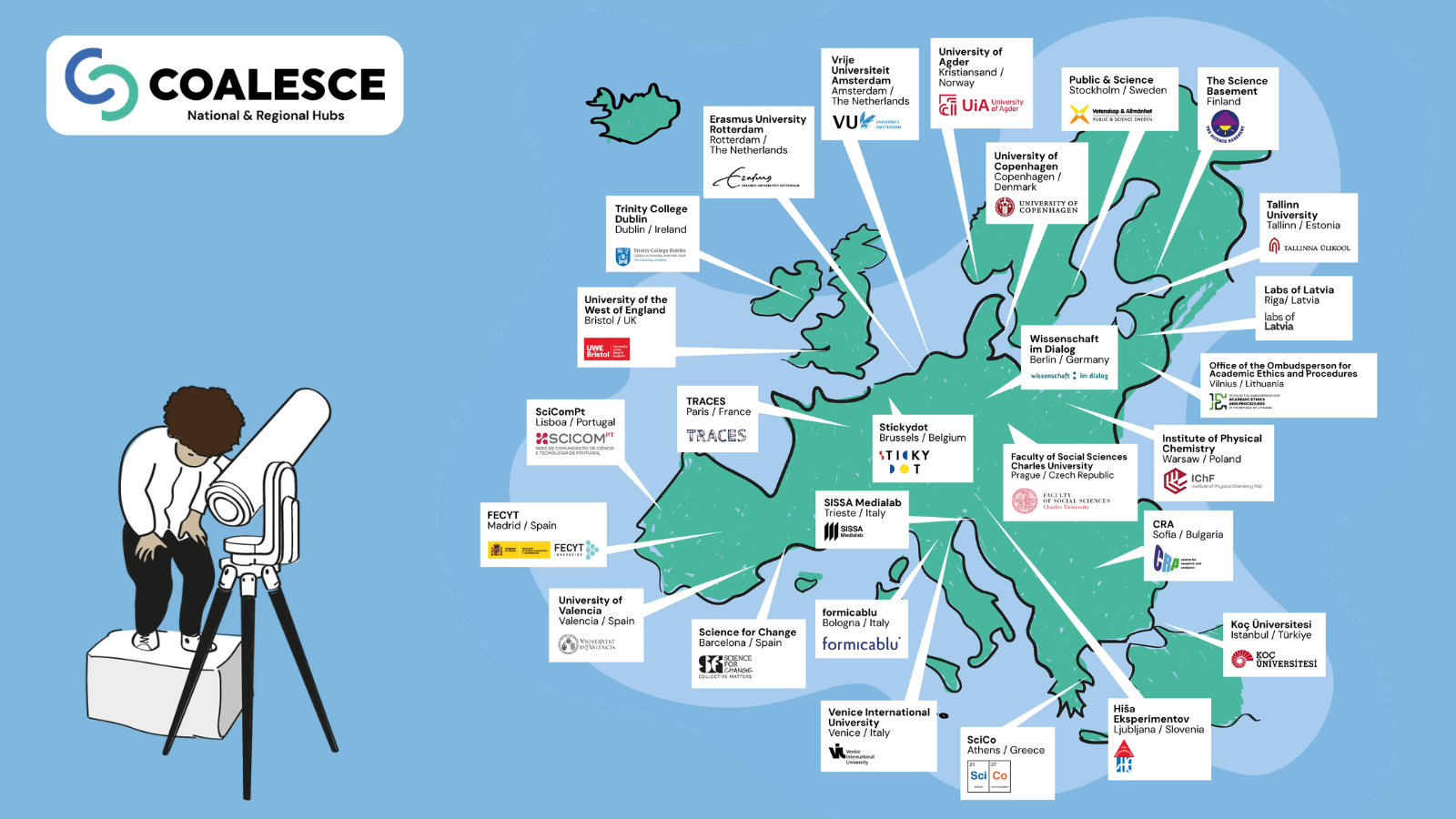
Five new COALESCE Hubs have joined the project – bringing the total number of Hubs to 27, spanning northern, southern, eastern and western Europe. Organisations in Denmark, Finland, Greece, Norway and Poland joined COALESCE in the third and last enrollment period of the project.
The COALESCE project will end in 2027, but the European Competence Centre for Science Communication, which it is developing, will be a self-sustaining organisation, and plans are being made to maintain the COALESCE Hubs network, which will play a key role in the Competence Centre’s activities in the long term.
“There will no longer be any calls for new Hubs to join us during the project, but we are establishing a system that will allow sustained growth in countries’ involvement, particularly for those that do not yet have a science communication ecosystem in place and need support and guidance from others,” says Joana Magalhães, co-coordinator of COALESCE and Science Communication Area Manager at Science for Change in Barcelona.
Three enrollment periods welcomed a total of 15 organisations from 15 different countries, in addition to the 12 partners from seven countries that are leading the project. The latest Hubs to join were welcomed at the first Hubs meeting of 2026 in February. The organisations enrolled as Hubs include science centres, universities and SMEs. They each have expertise in science communication and will adapt and share resources made available within the European Competence Centre for Science Communication in their countries, as well as provide training. They also bring new, contextualised knowledge and audiences to COALESCE.
“The role of the Hubs is fundamental to understanding national science communication contexts and contributing to a coordinated international network that brings local knowledge, languages and audiences,” says Magalhães.
COALESCE partners and Hubs are currently developing plans to ensure the future sustainability of the Competence Centre and the Hubs network, including potential business models that could include a membership approach or different revenue streams for Hubs, Magalhães explains.
The Hubs will be invited to participate in two Mutual Learning and Exploitation workshops in April and September 2026, where the goal will be to co-create national sustainability roadmaps with long-term actions aligned with the policy recommendations from the Mutual Learning Exercise in Science Communication in Research and Innovation, also conducted under COALESCE.
Meet the new hubs
“You are officially now a COALESCE Hub, so let everyone know about it,” encouraged Andy Ridgway, at UWE’s Science Communication Unit, at the Hub welcome meeting.
University of Copenhagen, Denmark
 The Science Communication research group, part of the Department of Science Education at the University of Copenhagen, was created in 2019 and currently has four members. As a COALESCE Hub, the team aims to bridge the gap between theory and practice, knowledge and action – especially in sustainability science communication. In 2023, they ran a series of workshops with citizens, artists, scientists, civil servants, students, and educators, using arts-based methods to map the sustainability communication landscape in Denmark, and are currently coordinating a research project, Sustain-Art-Sci (2023-2027), with arts-based public engagement in sustainability.
The Science Basement, Finland
 The Science Basement is a non-profit science communication organisation led by and for early-career researchers. Established in 2018, the team provides a safe space for researchers to develop science communication skills, learning by doing through hands-on projects, one-off events and an internal training series. Despite being based in Helsinki, the project is run in English and is open to researchers across Europe. As a COALESCE Hub, The Science Basement will help spread best practices and train a new generation of science and research communicators.
SciCo, Greece
 SciCo (Science Communication) is a non-profit organisation dedicated to making science accessible, engaging, and impactful for society. It was created in 2008 and currently operates as a social enterprise. SciCo provides a range of services, from talks and workshops to the production of training materials, STEM activities, citizen science programmes and the organisation of large-scale events such as the Athens Science Festival. As a COALESCE Hub, SciCo brings expertise in international and multi-organisational networks, as well as in co-creating practical toolkits and training sessions. The team hopes to scale up successful projects, adapt them locally, and increase their societal impact by connecting research with diverse publics.
University of Agder, Norway
 The University of Agder, located in Kristiansand, was officially recognised in 2007, but its roots date back to the first half of the 19th century. Last year, the university was awarded the EUPRIO Awards 2025 for the Red Flag Campaign, a student-led campaign aimed at preventing sexual harassment by encouraging reflection among potential perpetrators. The university exported the Researchers’ Grand Prix – a science communication competition for PhD candidates – to the FORTHEM Alliance, a network of nine multidisciplinary public research universities in Europe. As a COALESCE Hub, the team plans to share its expertise in research communication and crisis communication.
Institute of Physical Chemistry, Poland
 The Institute of Physical Chemistry, part of the Polish Academy of Sciences, was founded in 1955. The institute coordinates the Dream Chemistry Award, a competition in which young scientists with a chemistry background submit an idea for a scientific project they dream of solving. For the future, the institute plans to further develop a STEAM-based communication model, integrating imagination, storytelling and creativity as tools for communicating research and embedding it more deeply within research culture. For the COALESCE Hubs Network, they suggest job shadowing among members to strengthen institutional practices and share expertise.
Correction on 06/03/2026, 17:00. Total of 27 Hubs (not 28); 12 partners from seven countries leading the project.