Structural funding, advanced planning and engaging communities are key to crisis communication
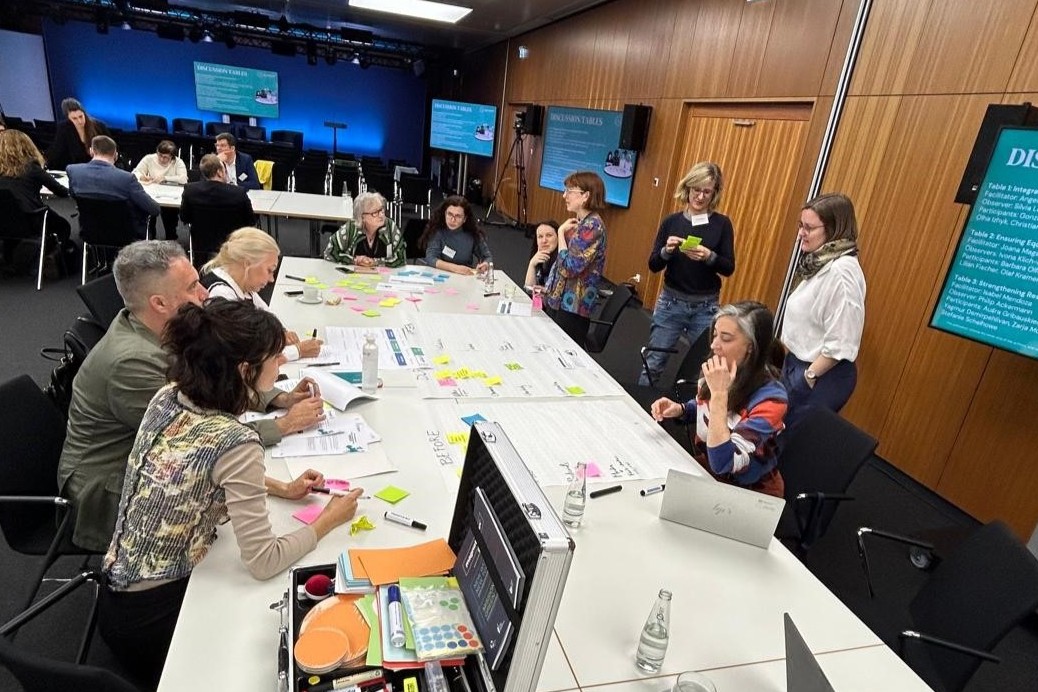
Over 30 participants from twelve different countries gathered in Berlin to discuss “Rapid mobilisation of science communication in times of crises and misinformation”. The meeting was organised by COALESCE together with the INSPIRING ERA project and hosted by the German Federal Ministry of Science, Technology and Space, on 25 March 2026.
This was the third topic session from the Mutual Learning Exercise (MLE) in Science Communication in Research and Innovation. The MLE aims to strengthen European and national support for science communication by enabling the European Research Area (ERA) Member States to jointly explore specific policy challenges and opportunities. INSPIRING ERA was a natural partner for the session, because it is a Horizon Europe project that helps turn policy into practice by connecting the people who create policies with those who make use of them on the ground.
The full-day meeting was divided into three parts:
- Panel discussion on “Building trust towards times of crisis” with Olha Izhyk, Risk Communication Officer in the European region at the World Health Organization (WHO Europe); Olaf Kramer, Professor of Rhetoric & Knowledge Communication at the University of Tübingen; Yagmur Demirpehlivan, Communications Manager at the Charité Center for Global Health (Berlin); and Paula Gori, Secretary-General at the European Digital Media Observatory (EDMO).
- Lightning Country Snapshots: seven countries – Estonia, Germany, Ireland, Lithuania, Portugal, Spain, and the UK – presented one recent crisis where science communication failed or was insufficient, and one science communication success story, at the national level.
- Co-creation session in three parallel tables (early warning systems, equitable access, and misinformation).
Plan communication and build trust before the crisis hits
One pivotal message arises from the panel discussion: plan ahead. In the same way that emergency services need to prepare structures, staff, and coordinated responses in advance, communication should do the same. In stressful situations, people rely mainly on close connections and are more vulnerable to misinformation. A message on an official website will not have the same impact as what your friend tells you at the dinner table, so building trust and investing in human connections has to come before the crisis, not during. “The moment you have a crisis, you are already too late,” Paula Gori says.
Media literacy needs to be improved, resilience to mis- and disinformation must be fostered, and communication strategies ought to be planned. Uncertainty is a constant in times of crisis, but that’s not the problem, Olha Izhyk argues; the problem is how we handle it. “The WHO formula is: say what you know, what you don’t know, and what you are doing about it,” she says.
What you say and how you convey messages – transparent, short and actionable information – are key to crisis communication, but it is also important to consider who says it and to whom. Communities must be part of the communication process, not just final target audiences, if we want to build trust within these groups, Yagmur Demirpehlivan highlights.
We need to meet people where they are (not where we want them to be), while using recognised voices to spread the work, Olaf Kramer adds. “There is no community that is hard to reach,” he supports, “but communities that are hardly reached”.
No transparency, no trust
The COVID-19 pandemic is often used as a case study for crisis communication, illustrating both best and worst practices – as reflected in several of the country examples presented in the Lightning Snapshots. Government representatives highlighted challenges that can also be faced in other emergencies: mis- and disinformation, polarisation, controversies and scandals involving authority figures, unbalanced media coverage, lack of transparency and failure to communicate uncertainty. Rigid narrative control, defensive communication and poor handling of disclosures are also ineffective approaches and do not foster trust.
Whether related to health emergencies, wildfires or long-term crises, countries shared important lessons learned, such as fostering cooperation and coordinated communication and responses, identifying experts in advance for different topics, working within the communities and making scientific evidence relevant to societal issues, and creating a myth library for early pre-bunking of mis- and disinformation and polarised arguments. As noted earlier, it all comes down to preparedness and adequate planning.
Integrating science communication in early warning systems was equally the topic of one of the working groups. Participants identified what should be done before, during and after the crisis, including increased funding for preparedness and training of key actors such as school teachers, science communication experts, science journalists, researchers and local spokespersons within communities.
Working with communities, understanding how to reach them effectively, co-creating strategies that integrate hard-to-reach groups, promoting trust brokers, and funding community mediators were among the solutions raised at the second table, discussing how to ensure equitable access to crisis information.
To prevent, detect and respond to misinformation while strengthening resilience, participants in the third table also highlighted the need for funding, coordination, and bottom-up approaches to reach underserved communities. They noted that literacy is important both for the general public and for researchers, and that response strategies should not be dependent on political cycles.
At the end of the session, Philip Ackermann, INSPIRING ERA coordinator, summed up the main recommendations from this session:
- Never forget that the human dimension is a key element in building trust in science
- In times of crises, policymakers are ‘forced’ to become science communicators
- We need to anticipate how AI is used to communicate science in crisis situations
- There needs to be a regular dialogue between science and policy
The insights, challenges and solutions discussed during the meeting will contribute to a policy report developed as part of the Mutual Learning Exercises in Science Communication in Research and Innovation. The report will be made available through the COALESCE website and the European Competence Centre for Science Communication (join the community here), supporting ongoing efforts to strengthen crisis communication across Europe.