Trust in science remains high in Europe, but not among all audiences
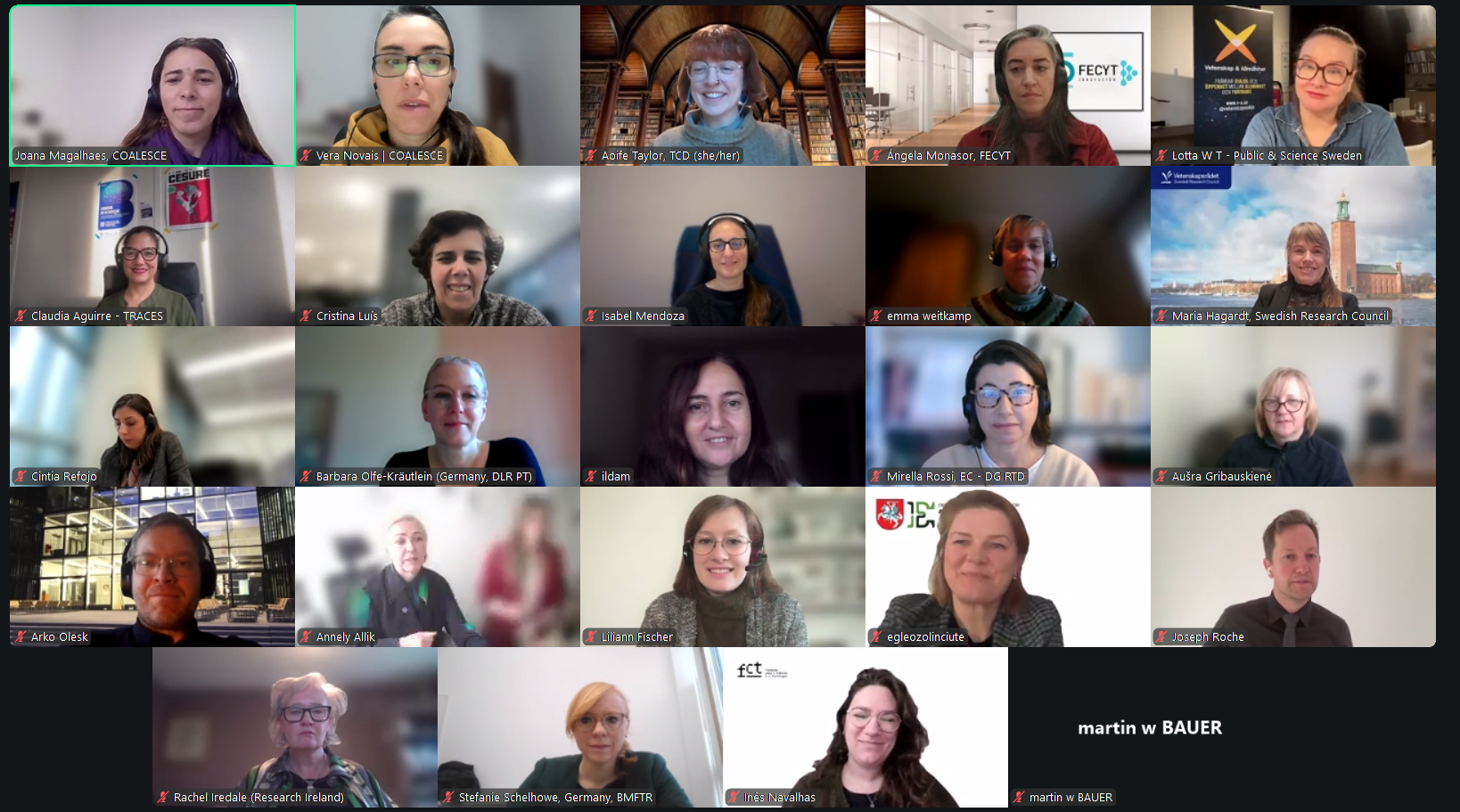
“There is no problem of trust.” Quite the opposite, Martin W. Bauer, Professor at London School of Economics and Political Science, said: “there’s an increasing level of trust”. The statement may sound counterintuitive, given that we are surrounded by widely shared perceptions that are convenient for certain stakeholders. Still, the view was supported by the other speakers in a session on monitoring public trust in science. The online session, organised by COALESCE partners, took place on 21-22 january 2026.
The meeting, “Social perception of science, trust and citizen engagement”, formed the second Mutual Learning Exercise. This platform for discussion brought together COALESCE Hubs and government representatives from nine European countries: Estonia, France, Germany, Ireland, Lithuania, Portugal, Spain, Sweden and the United Kingdom. The Spanish Foundation for Science and Technology (FECYT) and Trinity College Dublin were the COALESCE partners organising the session, with contributions from the University of Valencia and Science for Change.
Liliann Fischer, from Wissenschaft im Dialog (WiD), Germany, corroborated that the data collected by the German science barometer (Wissenschaftsbarometer) do not always align with what ‘public perceptions’ suggest (simply put, word of mouth). Running the barometer on trust in science annually, the WiD team observed an increase in trust during the COVID-19 pandemic, despite widespread claims of declining trust.
The speakers agreed that long-term surveys are fundamental to identifying trends and comparing results. However, more fine-grained research is also needed – to monitor sudden shifts, understand why trust in science is lower among younger generations, and segment audiences into relevant target groups. Annely Allik, Head of Science Communication at the Estonian Research Council, highlighted that Estonian-speaking respondents tend to trust science more than Russian-speaking counterparts, despite living in the same country.
Running regular or occasional surveys is largely dependent on the funding that research teams can secure. Joseph Roche, from Trinity College Dublin, Ireland, explained how the Trust in Science and Science-Related Populism (TISP Many Labs) study sought to overcome this obstacle by bringing together an international team of 241 researchers to survey 71,922 people in 68 countries – with each country funding its own survey. Roche represented one of the institutions taking part in this project, led by Viktoria Cologna, then Postdoctoral Fellow at Harvard University, and Niels G. Mede, then Senior Research and Teaching Assistant at the University of Zurich. The results were published in open access by Scientific Data, Nature, in january 2025.
Methods also differ from country to country. Public & Science Sweden (Vetenskap & Allmänhet) has conducted an annual survey since 2002, but the organisation has experienced a decline in response rates (from 60% to 35%), according to Lotta W. Tomasson. Sweden conducts its survey via telephone interviews, whereas Spain relies on face-to-face interviews. However, other countries have moved partially or entirely to online surveys, which are cheaper and tend to yield higher response rates.
To discuss technical and methodological details – which governmental stakeholders often show limited engagement with – Martin W. Bauer invited COALESCE partners and Hubs to join an informal network of researchers willing to exchange challenges and best practices related to trust-in-science survey methodology. The next meeting is planned for late 2026 or early 2027.
On the second day of the meeting, participants shared examples of public engagement in science and citizen science projects. They also discussed how those involved in these dialogues and activities valued being part of the process. However, one important question remains: do these activities strengthen trust in science?
Related article: Mutual learning exercise explores how policies can support science communication