Sign up for the Competence Centre platform and start networking and sharing opportunities
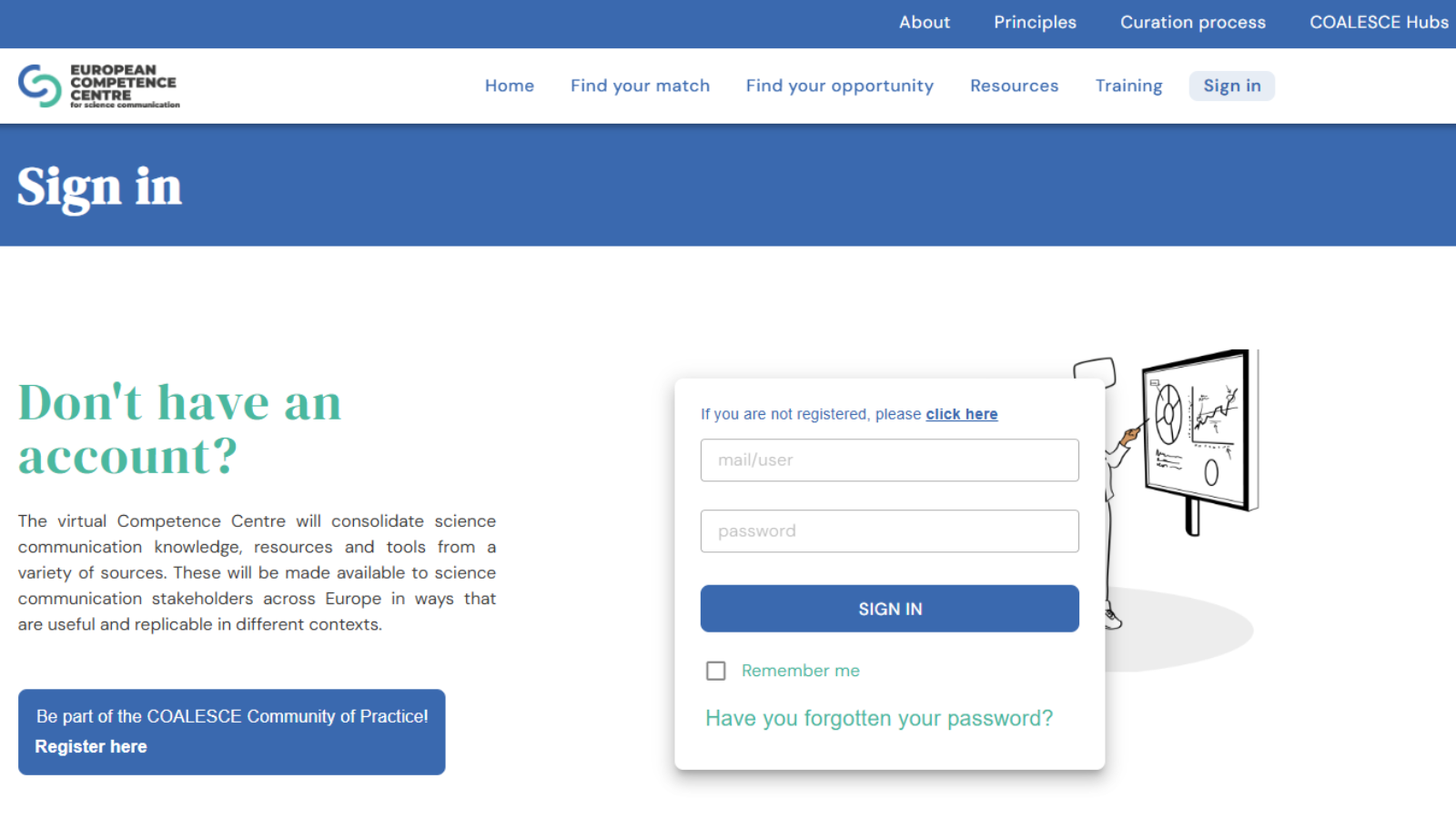
An interactive feature has been added to the European Competence Centre for Science Communication platform – the science communication opportunities area.
This area has been developed to enable anyone interested in or involved in science communication to connect with one another more easily, particularly those interested in finding expert sources in science communication as well as potential partners for funding opportunities.
The Competence Centre is inviting science communicators, journalists and scientists, as well as anyone working in related fields, to create a profile on the Competence Centre platform and explore which individuals and organisations are also there via the “find your match” navigation tool. The tool is searchable by area of work or expertise. This means that anyone visiting it will be able to find the right type of professional or organisation, with the right type of know-how.
The platform also allows anyone with a profile to find opportunities, such as opportunities to collaborate on project proposals.
By registering on the Competence Centre platform, users will also be invited to join a Community of Practice, which already has more than 1000 members, providing the ability to contribute to participatory activities and mutual learning events.
The Competence Centre is being developed within the European Union-funded COALESCE project. Over the coming months and years, it will provide anyone communicating science with high-quality curated resources and inspiration to support their work, as well as guidance on how to tackle challenges such as misinformation. The Centre will also provide science communication training.
COALESCE co-leader Joana Magalhães at Science for Change, Barcelona, said: “Launching our first interactive feature of the Competence Centre is an important milestone and is an example of how we are working to respond to scicomm community needs. In the last two years, more than 5000 people have watched or participated in our activities and shared their needs and concerns. Supporting individuals and organisations involved in or interested in science communication to connect more easily has always been a central goal. We have a structured plan for the next upcoming months to continue delivering and involving the community in what is meant to be the one-stop shop for high-quality scicomm in Europe and elsewhere.”
“If you are interested in or involved with science communication in some way, now is the time to sign up and become more visible to the people and organisations across Europe you would like to connect with.”
Anyone communicating science, including scientists, bloggers, vloggers, museum curators and science centre staff, journalists and communication officers are encouraged to sign up and create a profile. As are science communication trainers, and policy/decision-makers working in fields relevant to science communication. Institutions can also be registered. Visit scicommcentre.eu to sign up, create a profile and explore.
The opportunities area feature means that if a scientist would like to connect with an expert in public engagement or an artist, they can create a post that will enable that. Equally, if a science museum curator wants to collaborate with a scientist with expertise in AI or climate change, they will be able to find and connect with them on the platform. Experts publishing their needs may also choose to receive private messages or make the conversation public.
COALESCE co-leader Jason Pridmore at Erasmus University Rotterdam said: “We believe that the ability of our users to find individuals and organisations they can trust will be seen as an important feature of the platform.”
Registering on the platform will give you access to the growing resources that will soon be available there, including a crisis navigator, providing insights into how to communicate science more effectively at times of crisis. It will also enable you to participate in multiple activities within our Community of Practice and contribute to the co-creation of the Centre.