Seeing science clearly: a research-informed guide to visual science communication

Illustrations, video abstracts, data visualisations, along with theatre, dance and collaborative art are examples of the wide range of visual methods used to communicate science. Choosing the best approach to convey research can be challenging. A new resource created within the EU-funded COALESCE project, SciComm Note – Sight, provides a concise research-informed insight into the strengths and weaknesses of communicating science visually, as well as inspiration on different approaches and key considerations.
The SciComm Note has been developed by researchers at the University of the West of England (UWE) in the UK and Erasmus University in the Netherlands. It is one of the resources created for the European Competence Centre for Science Communication aimed at supporting the work of anyone who communicates science and is informed by recent research.
Whilst this SciComm Note is focused on sight, another will focus on sound, and a further note will focus on the other senses. The notes aim to synthesise existing knowledge, rather than collect new data or propose specific recommendations, explains Clare Wilkinson, lead author and Director of the Science Communication Unit at UWE. The current note assembles evidence on which visual techniques are well established and which are still emerging, as well as their strengths, weaknesses and impacts.
“Sight was a good place to start, since visual methods in science communication have long been used,” Wilkinson says. The amount of new knowledge generated by science communication research can sometimes be overwhelming – especially for those new to the field or those who need to refresh their skills. That’s where the SciComm Notes come in. “It draws together some of this recent research in a way that is accessible to a range of people,” says Wilkinson.
For this SciComm Note, the analysis includes research published and indexed in Scopus, ScienceDirect and PubMed between 1 January 2019 and 1 January 2025, but excludes conference papers, abstracts, editorials and grey literature. The 36 items analysed can also be found in an associated open-access database.
“Our hope is that people will be able to utilise the overview provided in the SciComm Note and then, if they wish, follow up on a particular point or locate further guidance in the database. They will be able to consult the original research that may be best suited to their interests, with many of these resources available with open access,” Wilkinson adds.
The analysis enabled the team to identify gaps in current research associated with visual science communication, including issues related to the use of generative AI, the impact of low-quality and inaccurate communication, or accessibility concerns. “We hope that by sharing the materials freely and widely, we can encourage those working in science communication to reflect on some of the potential weaknesses we have identified and consider how to address them in their own work,” says Wilkinson.
The three SciComm Notes, as well as training and additional resources, will be available through the Competence Centre. The team welcomes feedback from science communicators using these resources via the COALESCE contact pages.
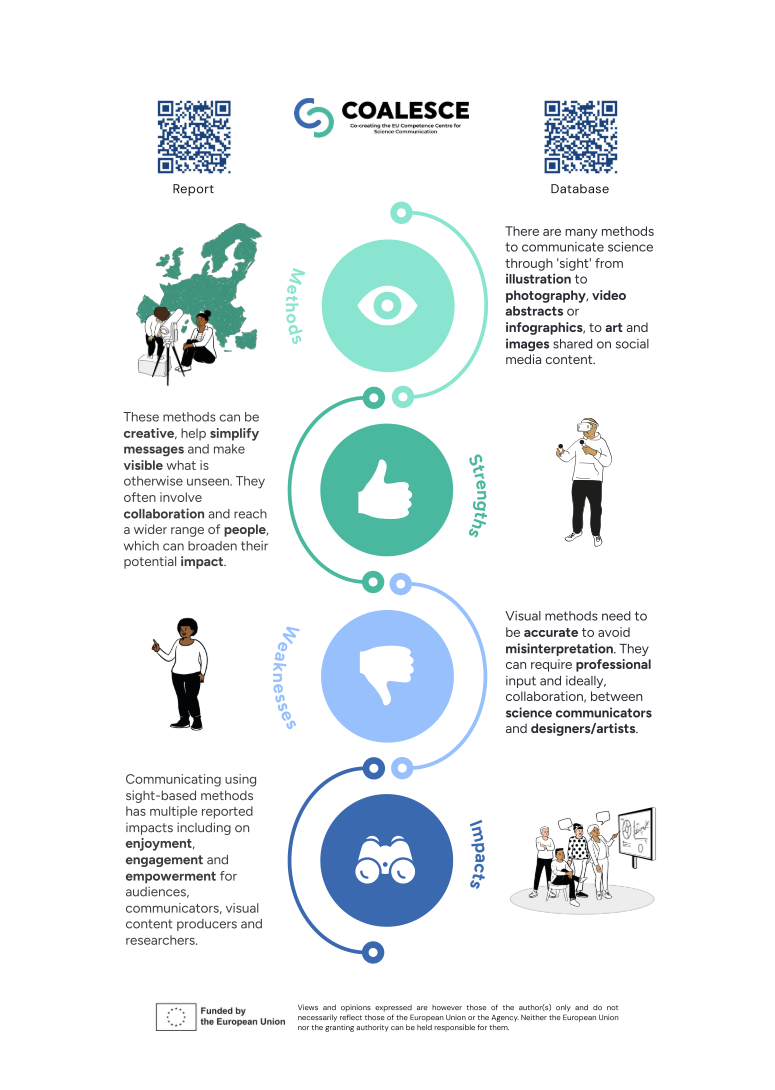
The infographic summarises the highlights in the SciComm Note on Sight. By Achintya Rao, UWE Bristol