|
For better science communication, plan ahead |
 |
|
When a crisis hits us – whether a suspected virus lab leak, an extreme weather event, or a major pollution episode – science communication must be mobilised quickly. But like an emergency kit, you need to prepare it in advance; otherwise, you risk relying on last-minute resources that may not be fit for purpose.
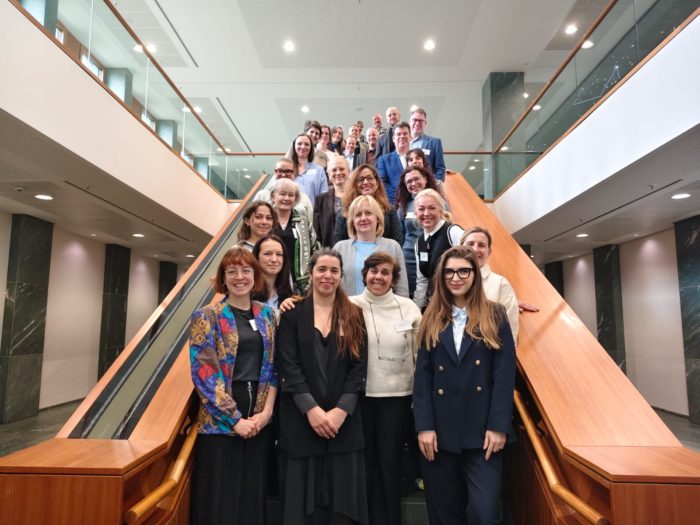
The participants at the third topic session from the Mutual Learning Exercise (MLE) in Science Communication in Research and Innovation, held in Berlin, reflected on the COVID-19 pandemic and other national examples to highlight the need for pre-planned and coordinated responses. Identifying experts and vulnerable communities in advance helps build trust and prepares communicators to respond to misinformation, which often spreads rapidly in times of crisis.
Similar conclusions emerged from a separate exercise focused on urgent and unexpected climate-related events. Preparing guidelines and best practices, training communicators, strengthening science and media literacy, and fostering trust in institutions and messengers were all identified as key priorities. The report outlining key considerations, barriers, solutions, and policy recommendations is now available.
While you are here, listen to our SciCom Conversations podcast with Prof Bruce Lewenstein (Cornell University). And before you leave, register on the recently relaunched platform of the European Competence Centre for Science Communication. See you there!
– The COALESCE communications team –
|
| |
|
Competence Centre Spotlight
|
| |
|
Step-by-step sign-up for the European Competence Centre for Science Communication platform
|
| |
|
The European Competence Centre for Science Communication, led by the COALESCE consortium, is virtual in nature and connected to a network of "physical" national and regional hubs (the COALESCE Hubs) across Europe and beyond. You can find it here: https://scicommcentre.eu/
The role of the Competence Centre is to consolidate existing knowledge of science communication, curate and make accessible quality resources, tools, training, and policy recommendations, to improve science communication for all actors in Research and Innovation. By registering on the platform (here), you’ll have access to all the tools and resources available.
Step-by-step:
- On the Competence Centre homepage (link here), find the “Sign in” option (in the upper right corner)
- Don't have an account? Click “Register here” to be part of the COALESCE Community of Practice
- If you already have an account, enter your details and click “Sign in”
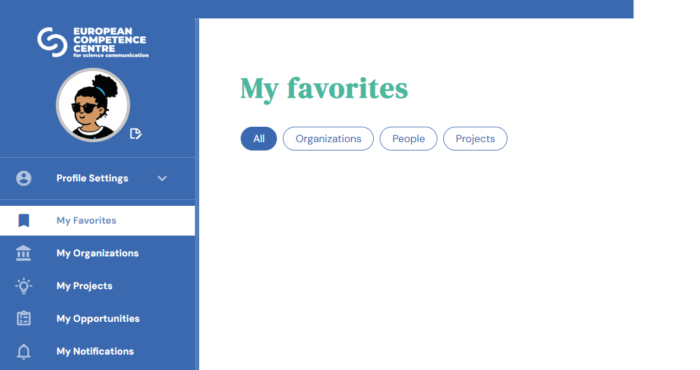
- Once you are logged in, check the column on your left and start filling out your profile settings:
- Add a photo or select one of our characters
- Add Personal Info, including your contact details
- Add a Professional Profile (Note: if you can’t find your organisation, you can add it to our database in “My Organisations”)
- Add your Expertise, as this will make it easier to match people
- Don’t forget to check our Policy Settings and choose if you want to make your profile public, so other members of the community can find you
- You can also add Organisations, Projects and Opportunities
- Promote your project by adding your project details
- Publish an opportunity if you are looking for people who could potentially collaborate on your project
- Ask for an expert if you are a journalist and need to contact someone in a given area
- Once you have uploaded your details to the platform, you can find your profile, other members’ profiles, and organisations in the “Find your match” area
- You can look specifically for a person, an organisation, or a project
- Or you can simply Explore who’s in
- Keep an eye on the “Find your opportunity” area – you may be able to support other members’ projects
- Contact us if you have any questions.
|
| |
|
Get ready for the upcoming free monthly training sessions
|
| |
|
The next SciComm Lunchtime training will focus on “Understanding the why and who of science communication: objectives, audience and its needs”. It will be held on 13 May 2026, from 12:30 to 14:30 (CET). Don’t wait – register here!
This session will guide participants from theory to practice, focusing on understanding the importance and objectives of communication, the audiences for science communication, and why it is important to consider audiences when designing science communication activities or resources. The training is intended for all those interested in science communication at a foundational level and will be run by Emma Weitkamp (University of the West of England) and Ilda Mannino (Venice International University) – COALESCE partners.
The following session, also for people at a foundational level, will be held on 17 June and will focus on “Science Communication Impact Evaluation”. This session will present principles and tools to evaluate public engagement activities, with a focus on matching the aims of an activity with appropriate evaluation methods.
The SciComm Lunchtime Series includes free monthly training sessions exploring different aspects of science communication — two hours long, every second Wednesday of the month. These sessions are designed for a range of target audiences. So far, we have covered topics such as “Identifying and tackling misinformation”, “Trust in Science”, and “Identifying governance gaps and the rise of disinformation”. |
| |
|
Plan ahead and have a consistent message: recommendations for climate crisis communication
|
| |
|
A new report with guidance on how to improve science communication in the face of urgent and unexpected climate-related events has been published. The report was developed by partners involved with the EU-funded COALESCE project and is specifically designed for science communication professionals, journalists, and practitioners who work on climate-related issues.
The report’s guidance is the result of the participatory session “Climate Communication in Crisis Workshop: Co-creating Early Warning Strategies”, held by COALESCE in Belgrade as part of the Climateurope2 festival.
The workshop, which involved eight participants, “served as the primary data collection phase, where we gathered the insights and evidence necessary to generate our results,” says Juan Romero Luis, Science Communication Researcher at Science for Change, a COALESCE partner and Hub. The report, which will be made available through the European Competence Centre for Science Communication, highlights three topics: key considerations for efficient science communication, barriers and solutions, and policy recommendations for urgent responses to climate crises. |
| |
|
Structural funding, advanced planning and engaging communities are key to crisis communication
|
| |
|
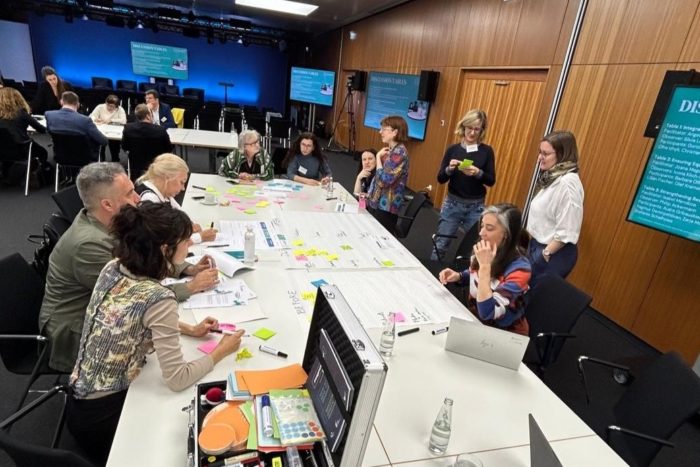
Over 30 participants from twelve different countries gathered in Berlin to discuss “Rapid mobilisation of science communication in times of crises and misinformation”. The meeting was organised by COALESCE together with the INSPIRING ERA project and hosted by the German Federal Ministry of Science, Technology and Space, on 25 March 2026. This was the third topic session from the Mutual Learning Exercise (MLE) in Science Communication in Research and Innovation.
The full-day meeting was divided into three parts: a panel discussion on “Building trust towards times of crisis”, Lightning Country Snapshots presentations, and a co-creation session in three parallel tables.
Whether related to health emergencies, wildfires or long-term crises, countries shared important lessons learned, such as fostering cooperation and coordinated communication and responses, identifying experts in advance for different topics, working within the communities and making scientific evidence relevant to societal issues, and creating a myth library for early pre-bunking of mis- and disinformation and polarised arguments. As noted in the same meeting, it all comes down to preparedness and adequate planning. |
| |
|
Koç University launches its Science Communication Certificate Program
|
| |
|
|
 |
|
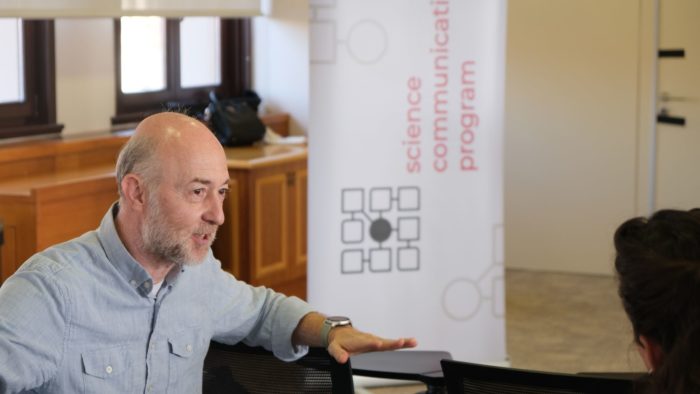
The Science Communication Certificate Program pilot edition had its kick-off meeting on 3 April 2026. The program is the outcome of a multi-year, evidence-based institutional process led by Koç University, a COALESCE Hub.
COALESCE’s framework strongly influenced the certificate program’s alignment with international standards, competence frameworks, and crisis-responsive science communication. The ‘train-the-trainer’ workshop, delivered in November and December 2025, also played an important role (as previously reported).
The Science Communication Program began with a full-day Foundations Day designed to establish a shared conceptual and historical framework for all participants. The Foundations Day included sessions such as Communication in Context, What is Science Communication?, Designing Understanding, Psychological Barriers to Communication, and Science Communication for Policy.
Then, the program moves into its technical module phase, with focused, hands-on, practice-oriented workshops across core themes such as Design Practices in Science Communication, Writing for Science Communication, Public Speaking and Creative Drama, and Media Production for Science Communication. Participants are also asked to attend at least five elective sessions and develop an original science communication project.
|
| |
|
Upcoming events |
Science Journalism Introduction Course
📅 29 April – 22 May 2026
🕑 17:30 – 21:30 (GMT+1)
📍 Online
🗣 Portuguese
🎫 Register here (Deadline: 27 April 2026)
The course has a total duration of 20 hours, organised into five four-hour online modules. Fifteen trainees who complete the training will be selected to attend the SciComPT Congress in Évora from 27 to 29 May and serve on the editorial team covering the proceedings. Coverage of the Congress will count as 30 hours of practical, independent, certified training. More…
__ __ __
SFC Academy: Citizen Science and Co-design for Climate and Sustainability
📅 6, 13 & 20 May 2026
🕑 14:00 – 16:00 (WEST)
📍Online
🗣 English
🎫 Register here
SFC Academy is an online training programme for those seeking to apply participatory approaches in European climate and sustainability projects. The programme combines real EU project case studies with practical tools and reflection applied to participants’ own professional contexts. It is aimed at professionals working in climate, environment, and sustainability (public sector, research, NGOs, consultancies, and EU-funded projects). More…
__ __ __
EUSEA Conference 2026
📅 19–21 May 2026
📍Esch-sur-Alzette, Luxembourg
🗣 English
🎫 Register here (Deadline: 30 April 2026)
The European Science Engagement Association Conference theme for 2026 is “In Other Words and Other Worlds: Confronting Assumptions for Better Engagement”. EUSEA brings together people who want to improve the relationship between research and society. If you work in public engagement, science communication, or use participatory or transdisciplinary approaches, this conference offers a valuable space to exchange ideas and practices. More…
__ __ __
SciComPt2026 Conference
📅 26–29 May 2026
📍Évora, Portugal
🗣 Portuguese
🎫 Register here (Deadline: 11 May 2026)
The Portuguese science communication congress SciComPt2026 is organised by the SciComPt – Portuguese Network of Science and Technology Communication and the University of Évora. This year, the conference proposes viewing science communication as a living heritage, focusing on Memory, Identity, and Sustainability. More…
__ __ __
2026 Ecsite Conference
📅 2–4 June 2026
📍Gothenburg, Sweden
🗣 English
🎫 Register here (Deadline: 20 May 2026)
Ecsite 2026 will take place at Svenska Mässan, the Swedish Exhibition & Congress Centre. Hosted by Ecsite member Universeum, the Ecsite 2026 programme offers a diverse range of sessions, practical workshops, and networking events, showcasing the breadth of expertise driving public engagement with science. More…
__ __ __
ReGeneration – EUPRIO Conference 2026
📅 8–11 June 2026
📍Metz, France
🗣 English
🎫 Register here (Deadline: 31 May 2026)
ReGeneration – Renewing Communication in Universities through Resilience & Innovation is the theme for the EUPRIO Conference 2026. Higher education communication professionals across Europe are invited to explore what it means to regenerate and reimagine professional practices, including when navigating science communication in a climate of mistrust or while integrating AI and new technologies without losing human connection. More…
|
| |
|