|
Practitioners connect with researchers in a new series of interviews |
 |
|
COALESCE has a vast network of Hubs across Europe, from Lisbon to Riga or Koç. It includes universities, science communication organisations, and even volunteer associations, with some more connected to research in science communication and others focused on science communication practice. How these apparently different worlds connect – what works, what doesn’t, and what needs to change – was the question we have challenged ourselves to answer. That’s how the SciComm Connections series of interviews was born.
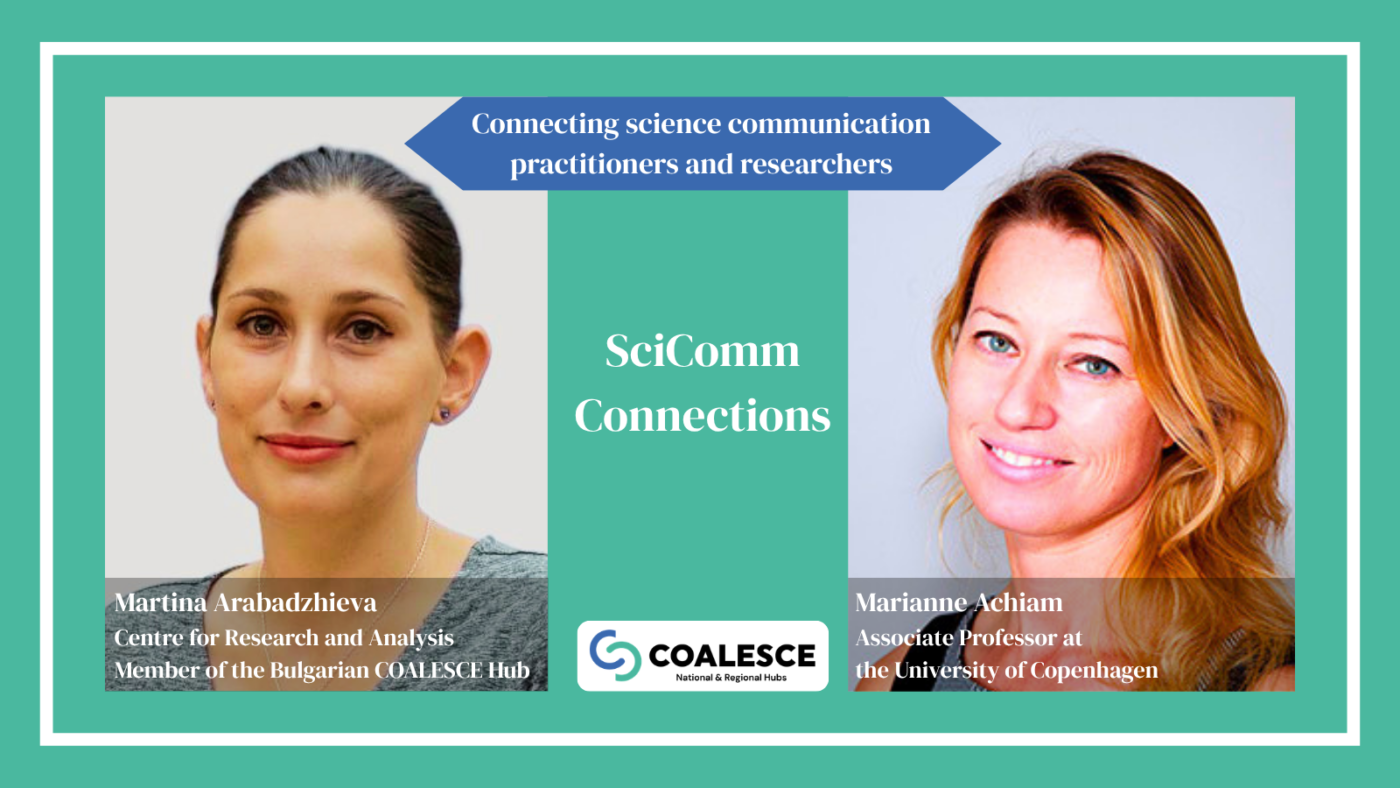
In our first article, we connect Martina Arabadzhieva, who represents the Bulgarian Hub and is part of the Centre for Research and Analysis (CRA), with Marianne Achiam, who leads a research group in science communication at the University of Copenhagen in Denmark. Both agreed that science communication practise should be taken seriously by the various stakeholders – and they would love to continue our chat for longer. You can read our first SciComm Connections article here.
Connecting people is also one of the Competence Centre's goals – have you registered yet? Bit by bit, we are adding new tools and resources to the platform to meet this goal. Our most recent tool is “Events”, where you can find conferences and training events, either online or in-person. If you know of any event that would be worth including, please contact us.
Also in this newsletter, learn about what happened at our latest Mutual Learning and Exploitation event (ML&E 6) and listen to our SciCom Conversations podcast with Hannah Little, Lecturer in Communication and Media at the University of Liverpool.
– The COALESCE communications team –
|
| |
|
Competence Centre Spotlight
|
| |
|
Find training, conferences, and more with the new Competence Centre tool
|
| |
|
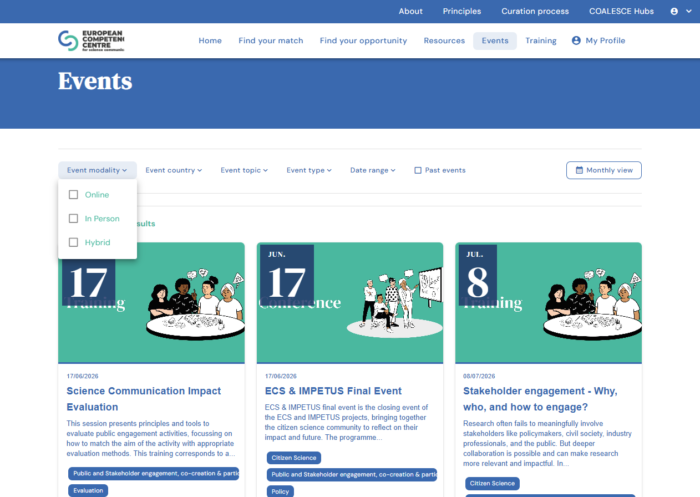
Check out the new feature on the European Competence Centre for Science Communication platform: the science communication Events page. Here you’ll find relevant conferences and other events taking place across Europe and beyond. Our Events page is also the place to find out about the science communication training offered by the Competence Centre. The events page will be a one-stop place for science communication practitioners and researchers to find out about events they would like to be part of or attend.
“Our team is curating a tailored calendar for science communication-related events happening all over Europe and beyond. Whether these are conferences, policy events or others, here is where you will be able to find them. You can also stay tuned with our regular training program and register from there. In the future, we will also be incorporating announcements about science communication prizes,” says Joana Magalhães, co-coordinator of COALESCE and Science Communication Area Manager at Science for Change in Barcelona.
If you would like to suggest an event to be included in the Competence Centre events page, please contact us here. Please provide the following information: title of the event; link to a relevant webpage; short description of the event; date(s) and time(s); event type, language, and whether it is online or in-person; event topic; and target audience. |
| |
|
SciComm Connections: "Researchers need to pay more attention to the problems identified by practitioners"
|
| |
|
Martina Arabadzhieva is a representative of the Bulgarian hub and is part of the Centre for Research and Analysis (CRA). The Bulgarian Hub includes several organisations – CRA, Beautiful Science Foundation, Forum Democritus and Muzeiko. On the other side of the virtual room sits Marianne Achiam, who leads a research group of four people in science communication at the University of Copenhagen in Denmark. COALESCE is in the middle, acting as a bridge in this paired interview series, where practitioners connect with researchers.
[Excerpt of the interview]
What barriers do you think science communication practitioners face, Martina?
[Martina] Well, the lack of journalists. Also, to be honest, academics don't always make information about their research easily available or understandable.
[Marianne] If I can add to that… Martina, you make a really good point, and express it somewhat diplomatically: researchers don't always make research available to practitioners. The problem, though, may be a bit bigger than that, in that it's quite easy for researchers to stay within the boundaries of academia and not worry so much about the real world and then be surprised when nobody in practice takes up their ideas of what's important. It’s not only a question of research not being accessible physically, but a question of having a more democratic model, perhaps, conducting science communication research in tandem with practice. We need to pay more heed to the problems identified by practitioners and their needs, rather than what we think is interesting from an academic point of view. |
| |
|
COALESCE Hubs given opportunity to connect with leading science communication networks in Europe and beyond
|
| |
|
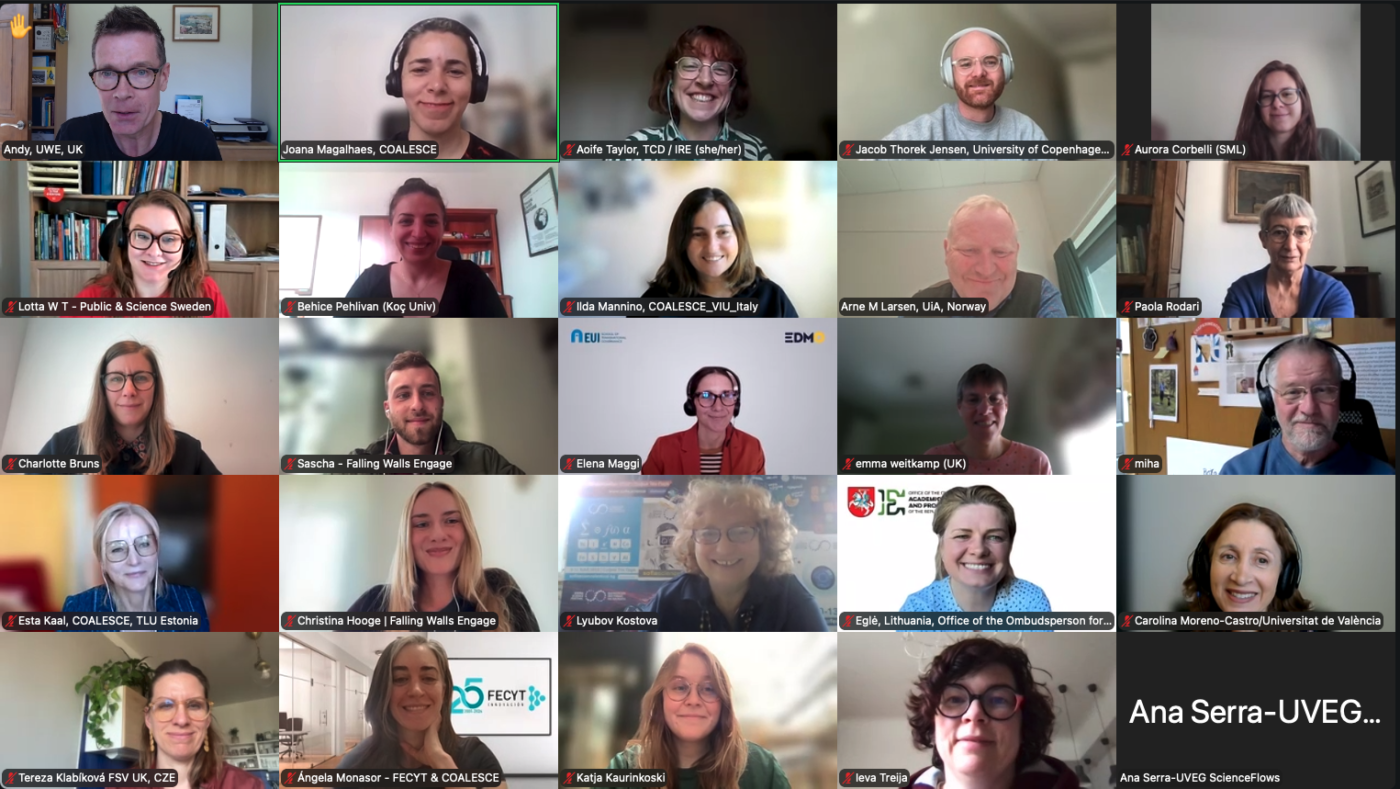
The latest Mutual Learning and Exploitation event (ML&E 6), which was held online, provided the opportunity for Hubs to hear about the work of the European Digital Media Observatory (EDMO) Hubs and Falling Walls Engage Hubs. It is planned to launch up to five small projects that would see staff at a COALESCE Hub working with either EDMO Hubs or Falling Walls Engage Hubs on disinformation or climate change communication projects.
At ML&E 6, Elena Maggi, EDMO Hubs Coordinator, described the work of their Hubs, which cover all 15 EU member states as well as Moldova, Norway and Spain. This network contributes to the detection and analysis of disinformation about health and climate, as well as organising media literacy activities. Sacha Hannon, Project Manager, International Networks at Falling Walls Engage, gave examples of its Hubs’ projects, in countries such as Argentina and Mexico, that are supporting science communication.
Representatives from the COALESCE Hubs were also briefed at the ML&E on the latest work to develop science communication competence frameworks for communication officers, researchers and museum staff. These frameworks will detail the science communication skills and know-how expected of these groups at different levels of expertise – foundation, intermediate, advanced and expert. The frameworks will be used to inform the development of science communication training within the Competence Centre training portfolio. |
| |
|
— SciComm Conversations: Non-human characters in science storytelling — |
|
In our second season of SciComm Conversations, we speak with science-communication researchers about their work. In the fifth episode, Dr Hannah Little, Lecturer in Communication and Media at the University of Liverpool, discusses the role of non-human characters in storytelling about science. The interview was recorded at the international conference of the Public Communication of Science and Technology (PCST) network.
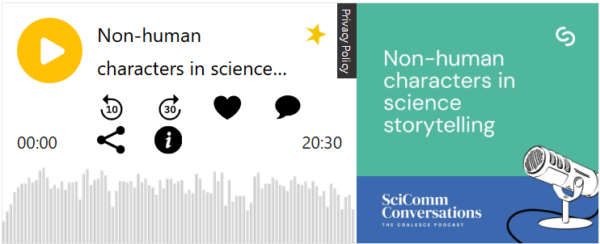
Read the transcript of the episode here.
|
| |
|
Upcoming events |
Stakeholder engagement - Why, who, and how to engage?
📅 08 July 2026
🕑 12:30 – 14:30 (CEST)
📍 Online
🗣 Englilsh
🎫 Register here
Research often fails to meaningfully involve stakeholders like policymakers, civil society, industry professionals, and the public. But deeper collaboration is possible and can make research more relevant and impactful. In this session, participants will be guided through methods for inclusive, needs-driven engagement, with ample room for discussion and shared experiences. This training corresponds to a Foundational Level of Competences. We welcome researchers, academics and citizen science project managers to participate. This training is part of the SciComm Lunch Time Series and will be delivered by Alexandre Torres, from Stickydot, a COALESCE partner. More…
__ __ __
European Conference of Science Journalism (ECSJ2026)
📅 14–16 2026
📍Hannover, Germany
🗣 English and German
🎫 Register here
The ECSJ2026 will be held jointly with the annual Wissenswerte conference of the Wissenschaftspressekonferenz (WPK), the German association of science journalists and a member of the European Federation for Science Journalism (EFSJ). On 14 and 15 October, the conference will be presenting a series of sessions, including panel discussions and workshops, under the main title: Science journalism for a World in Crisis. On 14 and 15, there will be sessions in English; on 15 and 16, in German. More…
__ __ __
Forum Wissenschaftskommunikation 2026 - Science Communication Forum 2026
📅 9–10 December 2026
📍Leipzig, Germany
🗣 German
The Science Communication Forum is the largest conference for science communication in the German-speaking world, organised annually since 2008 by Wissenschaft im Dialog, the joint German scientific organisation for science communication and a COALESCE Hub. "Coming together: Social cohesion in times of crisis" is the theme of the conference, which will take place at the Congress Hall at the Leipzig Zoo. More…
__ __ __
Visit our Competence Centre events page for more conferences, training and other events.
|
| |
|