|
scicommcentre.eu Newsletter #3: February 2026 |
View online
|
| |
|
Trust in science remains high
|
| |
|
|
 |
|
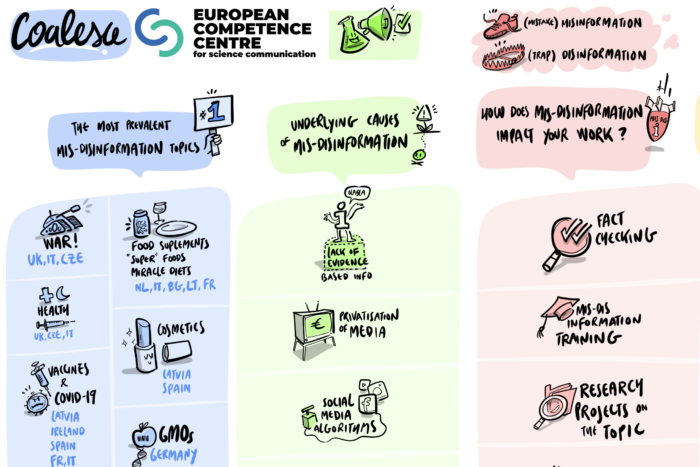
COALESCE continues to foster dialogue between Hubs and government representatives on key challenges for science communication. In january, the project held its second mutual learning exercise, focused on trust in science. While the policy briefing is still in preparation, you can already read a summary of how the session unfolded. You can also revisit the first mutual learning exercise on misinformation through an illustration by the artist Edgar Sanjuan.
Building capacity remains central to addressing these challenges. Behice Pehlivan, from Koç University — a COALESCE Hub — is keen to bring science communication training to Turkey, where she sees a clear need for capacity building. Supporting Hubs through tailored training is one of the core missions of the future European Competence Centre for Science Communication, and the recent train-the-trainer event was exactly what Pehlivan had been looking for.
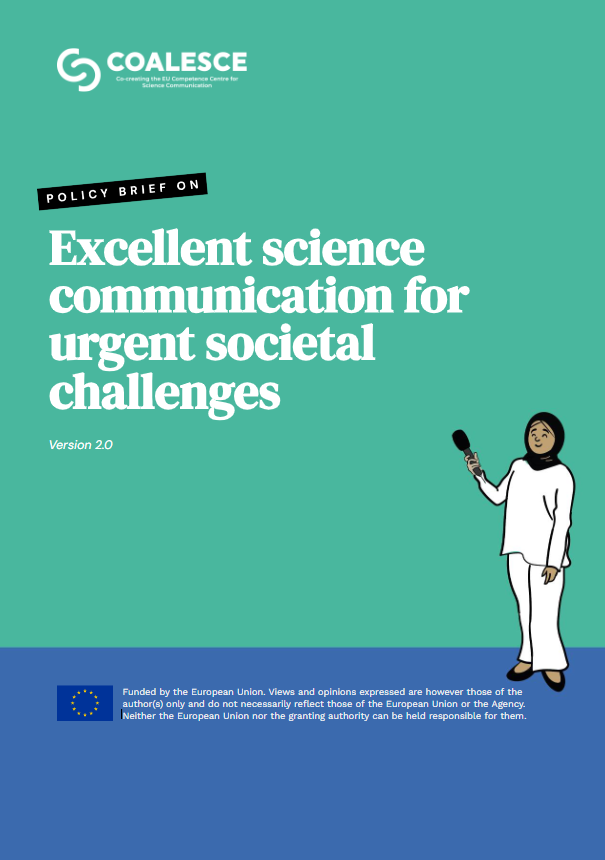
Take a moment to explore the revised policy brief on Excellent Science Communication for Urgent Societal Challenges, listen to the SciComm Conversations podcast, and make space in your agenda for the upcoming activities.
– The COALESCE communications team
|
| |
|
Competence Centre Spotlight
|
| |
|
‘Train the trainers’ at Koç University “straight to the point”
|
| |
|
Koç University had a need, and the COALESCE project offered the expertise. That’s how the first ‘train-the-trainer’ workshop for professors at this university was designed and delivered in november and december 2025. Three two-hour sessions explored the role of scientists in society and in science communication, the skills they need, and offered a brief overview of the history of science communication.
Behice Pehlivan, Head of Sustainability at Koç University, has been looking into this topic for more than five years, thinking of ways to create a talent pool in science communication for the future. After benchmarking extensively, the university decided to initially create a small certificate programme in science communication for doctoral students. “This seemed manageable, because you cannot just start a master’s or a doctoral programme – it's too big,” Pehlivan says.
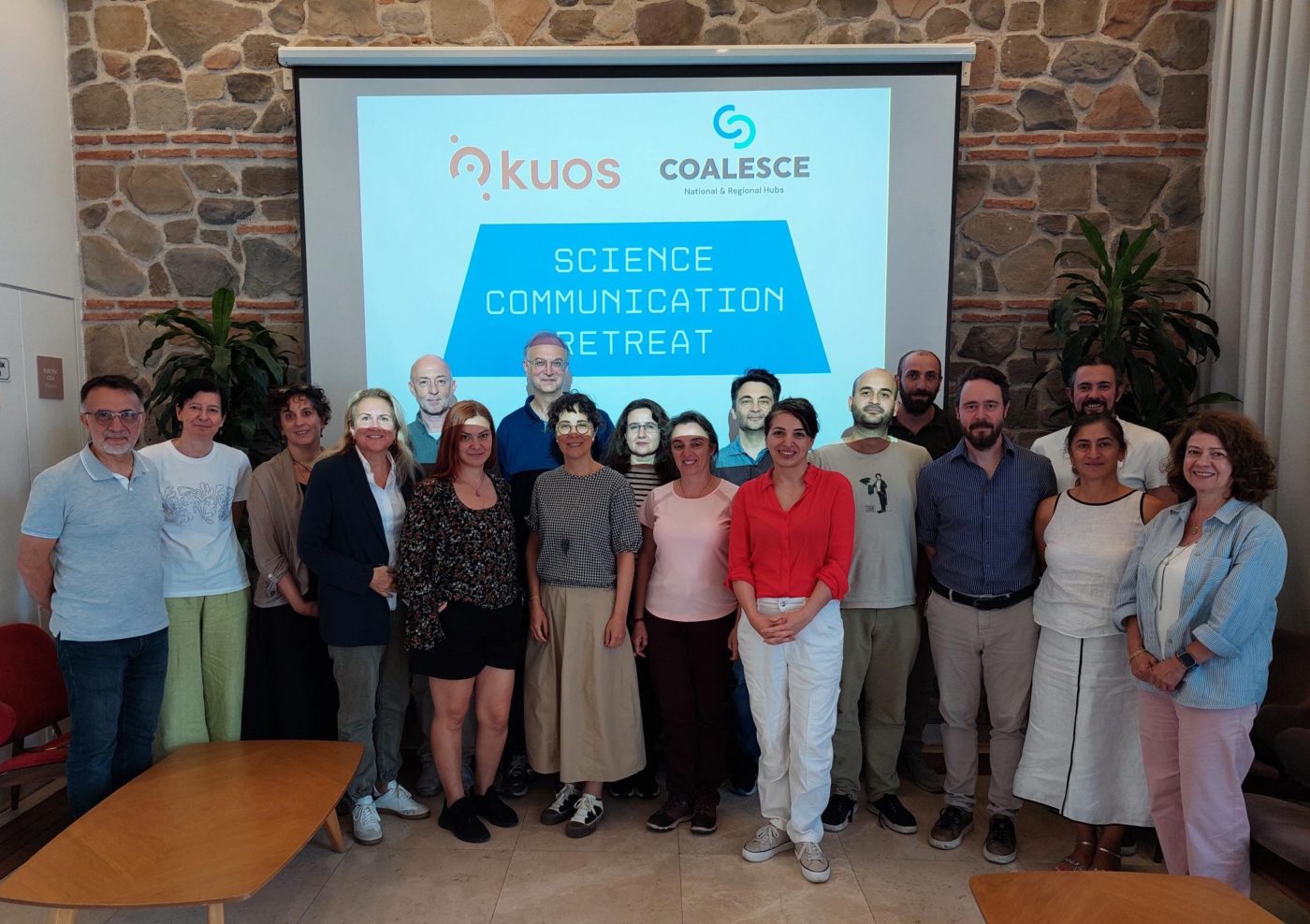
Pehlivan gathered a multidisciplinary cohort of around 20 people from the institution – graphic designers, sociologists, psychologists, medical scientists, biologists, and even a poet. After the retreat, they had already developed a rough draft of the pilot programme and identified potential trainers. What was lacking was expertise in science communication – and that’s where the ‘train-the-trainer’ event came in. |
| |
|
A series of free monthly training sessions starts in February |
|
Starting in February 2026, the new European Competence Centre for Science Communication will host a series of free, monthly, bite-sized online training sessions.
Later in 2026, the online Competence Centre will offer training sessions on trust in science, understanding audiences and their needs, and stakeholder engagement. Anyone involved in science communication is welcome to sign up and attend, including journalists, press officers, scientists, bloggers and vloggers, across Europe and beyond.
The first of these events, which focused on identifying and tackling mis- and disinformation, was led by Dr Andy Ridgway and Professor Emma Weitkamp from the Science Communication Unit at the University of the West of England. This institution is one of the partners in COALESCE, the EU-funded project that is developing the Competence Centre.
|
| |
|
Excellent Science Communication for Urgent Societal Challenges 2.0 |
|
This Policy Brief aims at fostering constructive exchange around science with reference to wicked problems – complex societal problems that lack straightforward solutions, like the climate crisis.
Such problems concern many different stakeholders with a diversity of values, emotions, types of knowledge and expertise. The new version of this policy brief comes after a process involving four different stakeholders: policy, academia, industry and civil society. |
|
|
| |
|
Trust in science remains high in Europe, but not among all audiences
|
| |
|
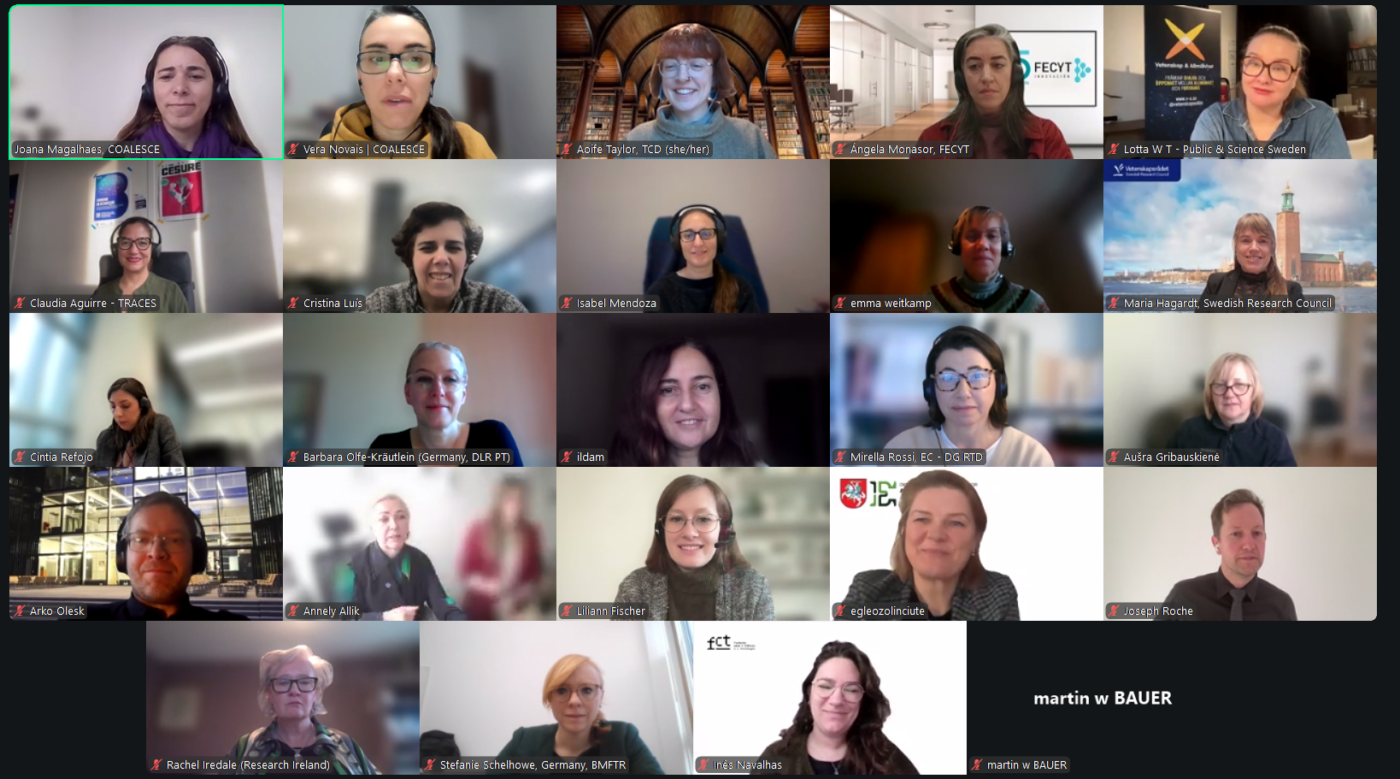
“There is no problem of trust.” Quite the opposite, Martin W. Bauer, Professor at London School of Economics and Political Science, said: “there’s an increasing level of trust”. The statement may sound counterintuitive, given that we are surrounded by widely shared perceptions that are convenient for certain stakeholders. Still, the view was supported by the other speakers in a session on monitoring public trust in science. The online session, organised by COALESCE partners, took place on 21-22 january 2026.
The speakers agreed that long-term surveys are fundamental to identifying trends and comparing results. However, more fine-grained research is also needed – to monitor sudden shifts, understand why trust in science is lower among younger generations, and segment audiences into relevant target groups. Annelu Allik, Head of Science Communication at the Estonian Research Council, highlighted that Estonian-speaking respondents tend to trust science more than Russian-speaking counterparts, despite living in the same country.
Running regular or occasional surveys is largely dependent on the funding that research teams can secure. Joseph Roche, from Trinity College Dublin, Ireland, explained how the Trust in Science and Science-Related Populism (TISP Many Labs) study sought to overcome this obstacle by bringing together an international team of 241 researchers to survey 71,922 people in 68 countries – with each country funding its own survey. |
| |
|
Upcoming events |
Wisskomm Connected call for proposals
📅 Deadline: 16 February 2026
🗣 German
🎫 Register your proposal
To strengthen the exchange between research and practice in science communication, the Transfer Unit is organizing Wisskomm Connected for the second time on October 21 and 22, 2026. Once again, we want to create a two-day space for the exchange of experiences between both communities and discuss together how to shape a strong and diverse science communication sector. More…
— — —
ECSA Conference 2026
📅 3-6 March 2026
📍Oulu, Finland
🗣 English
🎫 Register here
The 6th European Citizen Science Association Conference will be hosted by the University of Oulu during the year that Oulu is crowned one of the European Capitals of Culture. Besides the scientific programme, the conference will be accompanied by a pre-conference day dedicated to the ECSA working group meetings (2 March) and a day for excursions (7 March). More…
— — —
X International Congress AE-IC
📅 19–22 May 2026
📍Pontevedra, Spain
🗣 Spanish
🎫 Register here
The conference theme is "Communicating in uncertainty" and will focus on the major changes in the field of Communication from the point of view of academic research, knowledge transfer and the social commitment of researchers. More...
— — —
EUSEA Conference 2026
📅 20-21 May 2026
📍Esch-sur-Alzette, Luxembourg
🗣 English
🎫 Register here
The European Science Engagement Association (EUSEA) will celebrate 25 years #EUSEA26, under the theme: “In Other Words and Other Worlds: Confronting Assumptions for Better Engagement". Early-bird registration fees are valid from February until March 31, 2026. More...
— — —
Ecsite 2026
📅 2-4 June 2026
📍Gothenburg, Sweden
🗣 English
🎫 Register here
The Ecsite Conference is a friendly and approachable Conference ideal for anyone working in or supporting the field of science engagement, whether from Science centres or Museums, Natural History Museums, Science Festivals, Universities or more. More...
|
| |
|